Find us at booth #83, join us for a harbor side happy hour, or catch Gorish’s talk.

Sept, 16-18 > Learn more

%20(1).avif)
Mamta Tainwala

July 29, 2026
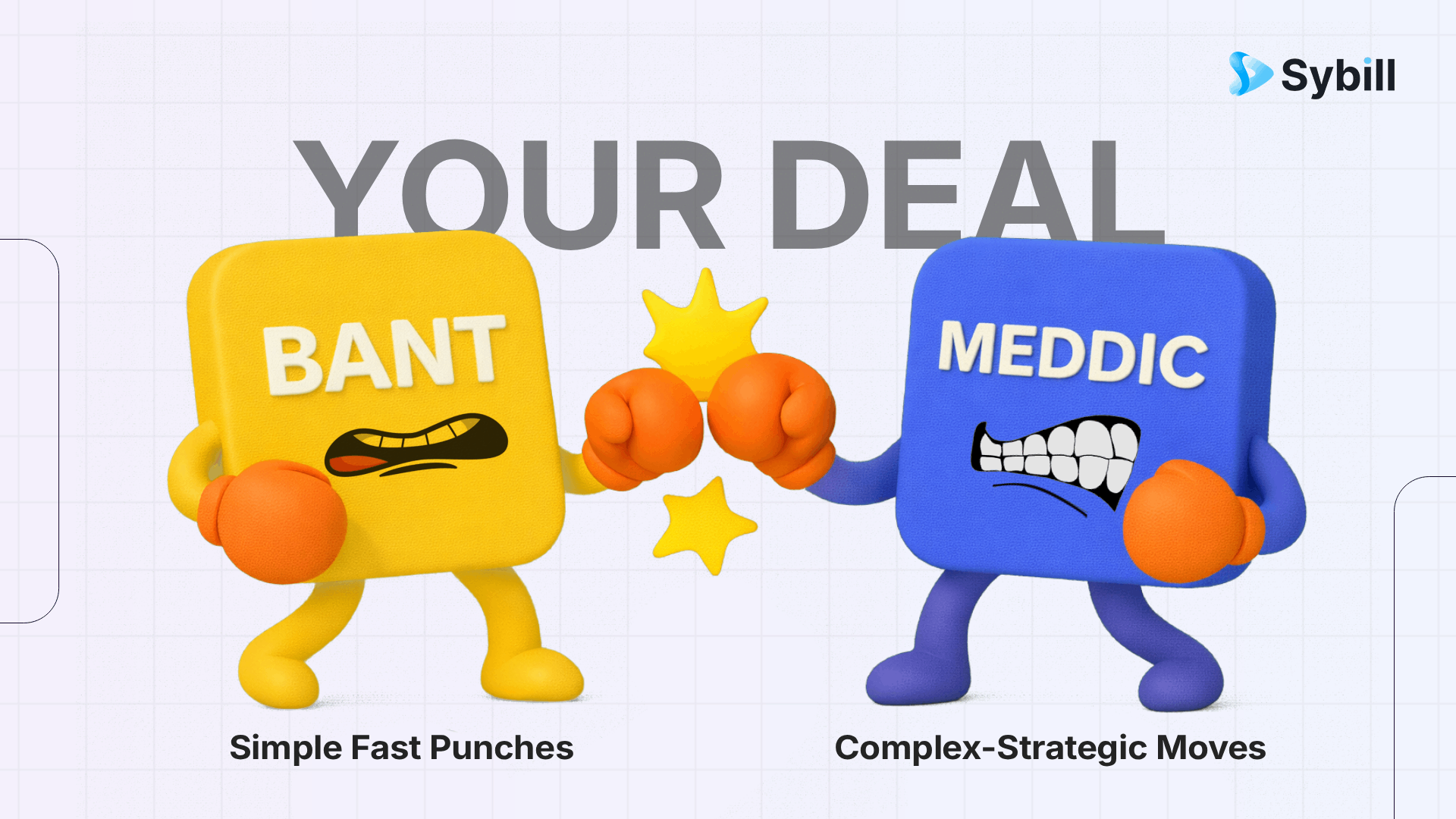
Remember when Neo had to choose between the red pill and the blue pill in The Matrix? Choosing between BANT and MEDDIC feels exactly like that. Except instead of learning the truth about reality, you're trying to figure out which acronym will help your team stop chasing zombie deals that were dead three weeks ago.
BANT has been around since the 1950s when IBM decided selling should be systematic. MEDDIC emerged in the 1990s when someone finally said "maybe enterprise deals are more complicated than Budget-Authority-Need-Timeline." Both have passionate advocates who'll swear their chosen framework is superior. Both have critics who claim they're outdated relics that don't reflect modern buying behavior.
BANT (Budget, Authority, Need, Timeline) is a lightweight four-criteria qualification framework best for high-velocity sales with deal sizes under $25K, short cycles, and 1-2 decision makers, while MEDDIC (Metrics, Economic Buyer, Decision Criteria, Decision Process, Identify Pain, Champion) is a comprehensive six-element framework built for complex enterprise deals above $50K with multiple stakeholders, longer cycles, and formal evaluation processes. The best sales teams in 2026 don't choose one exclusively — they use BANT for initial lead qualification and speed-to-response, then graduate promising opportunities to MEDDIC for deeper deal strategy, with AI tools like Sybill automatically capturing qualification signals from conversations and populating framework fields in the CRM so reps qualify thoroughly without drowning in admin work.
The real question isn't which one is "better". It's which one matches how your specific buyers actually buy, how your specific team actually sells, and what specific problems you're trying to solve. Use BANT when you should be using MEDDIC and you'll qualify deals too quickly, missing critical stakeholders and decision criteria. Use MEDDIC when BANT would suffice and you'll slow your pipeline to a crawl while your reps drown in complexity.
In this guide, we're breaking down exactly what each framework does, when each one works (and when it spectacularly doesn't), and how modern sales teams are combining both instead of treating them like religious doctrine. Whether you're a sales leader trying to standardize qualification, a rep confused about which questions to ask, or an ops person wondering why your CRM fields don't match reality, you're about to get clarity.
Let's start with the basics before we get into the cage match.

BANT stands for Budget, Authority, Need, and Timeline. It's the framework equivalent of a drive-through menu: simple, fast, gets you what you need without overthinking it.
Budget: Does the prospect have money allocated to solve this problem? Not "could they find budget" but "do they have it right now."
Authority: Is the person you're talking to the decision-maker? Can they sign the contract or are they just gathering information for someone else?
Need: Do they have a problem your product actually solves? Not "could they benefit from our solution" but "do they recognize they have a problem that needs solving."
Timeline: When do they need to make a decision? Are they buying this quarter or just exploring for some theoretical future state?
The beauty of BANT is that you can run through all four criteria in a single discovery call and know whether this opportunity is real or just someone kicking tires. It's qualification by elimination: if any of the four criteria is missing, the deal probably isn't happening.
IBM created BANT in the 1950s for selling mainframe computers to enterprises. The buying process was simpler then: one decision-maker, clear budget cycles, and if they had a need and money, the deal closed. Fast forward 70 years and BANT still works for similar situations: transactional sales, clear decision authority, and straightforward value propositions.
MEDDIC stands for Metrics, Economic Buyer, Decision Criteria, Decision Process, Identify Pain, and Champion. It's what happens when enterprise software companies realize that "does this person have budget" doesn't tell you nearly enough about a $500K deal with a 9-month sales cycle.
Metrics: What are the quantifiable business outcomes driving this purchase? Not vague goals like "improve efficiency" but actual numbers like "reduce onboarding time from 6 weeks to 3 weeks."
Economic Buyer: Who has the actual authority to sign the contract and release the funds? Not just influence, but the power to say yes and write the check.
Decision Criteria: What specific factors will they use to evaluate solutions? Features? Price? Existing relationships? Compliance requirements? What's the rubric they're using to score you against competitors?
Decision Process: What's the actual workflow that needs to happen internally for them to make a purchase? Who needs to be involved? What approvals are required? What's the timeline for each step?
Identify Pain: What's the specific problem causing them enough pain that they're willing to change? What happens if they don't solve it? How urgent is it really?
Champion: Who inside the organization is advocating for your solution? Who benefits most from it succeeding and will help you navigate internal politics?
MEDDIC was created at PTC (a software company) in the 1990s and helped them grow from $300M to $1B in four years. The framework assumes complexity: multiple stakeholders, long sales cycles, competitive situations, and internal politics that can kill deals even when the solution fits perfectly.
Over time, MEDDIC has evolved into MEDDPICC (adding Paper Process and Competition) and MEDDPPICC (adding Implications of Pain) as teams realized even six criteria weren't enough for certain enterprise scenarios.
Most comparisons focus on BANT being "simple" and MEDDIC being "complex." That's true but misses the bigger point. The frameworks have fundamentally different philosophies about what qualification means.
BANT's philosophy: Qualification is about filtering. Your job is to quickly identify which leads are ready to buy and which aren't. It's binary: they either have budget/authority/need/timeline or they don't. No budget? Disqualify and move on. Wrong person? Find the right one or move on. No timeline? Come back when they're ready.
BANT assumes scarcity of time and abundance of leads. The goal is velocity: move fast, close what's closeable, don't waste cycles on maybes.
MEDDIC's philosophy: Qualification is about understanding. Your job is to deeply comprehend the prospect's situation so you can navigate the complexity effectively. It's not binary; it's a scorecard. Weak champion? Invest in building a stronger one. Unclear decision criteria? Help them clarify it in your favor.
MEDDIC assumes abundance of time (relatively) and scarcity of good opportunities. The goal is precision: understand the deal deeply enough that you can forecast it accurately and influence the outcome.
This philosophical difference means you can't just "add more questions" to BANT and call it MEDDIC. They're solving different problems.
BANT gets unfairly criticized as "outdated" or "too simple" by people selling complex enterprise software. But for many sales situations, BANT is exactly right. Here's when:
If you're taking 50+ discovery calls per month and deals close in under 60 days, BANT's speed is essential. You literally don't have time to run deep MEDDIC qualification on every lead. You need to know quickly: can they buy? Will they buy? When?
SMB SaaS, inside sales teams, and anything with sub-$50K deal sizes usually fits this profile. Your rep can qualify a lead in 15-20 minutes with BANT and move on. Try doing MEDDIC in 20 minutes and you'll get surface-level garbage that doesn't help anyone.
When you're selling to small businesses or specific roles (like individual contributors buying tools for themselves), authority is straightforward. The person you're talking to can decide and buy. You don't need to map a buying committee because there isn't one.
BANT works perfectly here because the "Authority" question has a simple answer, and if the person has budget, need, and timeline, the deal happens.
When prospects are already using your product through a free trial or freemium model, you have a massive signal about Need (they're using it) and often Budget (they're getting value worth paying for). Your qualification conversation is really just about Authority and Timeline: who needs to approve expanding usage and when are they ready to do it?
BANT gives you the framework to quickly identify which active users are convertible to paid without over-complicating the motion.
If your sales team is small or your reps are inexperienced, BANT's simplicity is a feature, not a bug. You can train someone on BANT in an hour. They'll start using it effectively immediately. MEDDIC requires weeks of training, ongoing coaching, and experience to use well.
For startups or teams scaling quickly, BANT gets everyone to a baseline level of qualification fast. You can always add complexity later when the team matures.
MEDDIC takes more time and effort, but for certain sales motions, that investment pays off massively. Here's when MEDDIC is worth it:
If your average deal involves 5+ stakeholders, 6+ month sales cycles, and $100K+ contract values, BANT will leave you flying blind. You'll think deals are qualified based on one conversation, then watch them die three months later when an EVP you never knew about says no.
MEDDIC forces you to map the full picture: all the stakeholders, their individual pain points, the formal and informal decision processes, and who's actually championing your solution internally. This granularity is essential when deals are complex and expensive.
When you're going head-to-head against established competitors, knowing budget/authority/need/timeline isn't enough. You need to understand Decision Criteria (what factors matter most in their evaluation) and Champion (who inside will advocate for you over the incumbent).
MEDDIC gives you the framework to compete strategically instead of just hoping your solution wins on merit.
If deals take 6-12+ months with dozens of conversations, BANT's simple yes/no framework breaks down. The situation evolves. New stakeholders emerge. Priorities shift. Budget gets reallocated.
MEDDIC provides structure for tracking all these moving pieces across time. Each criterion becomes a workstream you manage throughout the cycle, not just a one-time check.
If your board expects accurate revenue forecasts or you're planning hiring based on pipeline, MEDDIC's thoroughness improves prediction. You're not guessing based on stage; you're scoring based on concrete criteria. "70% confident" means something specific: you've identified all six MEDDIC elements and confirmed most of them.
Teams using MEDDIC report forecast accuracy improvements from 60-70% to 85-95% because the qualification data is actually predictive of outcomes.
If your sales motion is about deeply understanding the prospect's business, diagnosing their problems, and prescribing custom solutions, MEDDIC aligns perfectly. You're already going deep; MEDDIC just gives you a framework for organizing what you learn.
The "Identify Pain" and "Metrics" components force reps to dig beyond surface-level symptoms to understand root causes and quantifiable impacts.
Let's talk about the problems nobody mentions in the "BANT vs MEDDIC" debate because they're trying to sell you software.
Problem 1: Modern B2B buying isn't this simple. Even "simple" B2B deals usually involve multiple people. The person with Need might not have Authority. The person with Budget might not see the Need yet. Treating these as binary yes/no questions oversimplifies reality.
Research shows the average B2B buying committee now has 6-10 stakeholders. BANT was designed for a world where one person had all four attributes. When was the last time you saw that?
Problem 2: The order matters but BANT doesn't acknowledge it. Starting with Budget ("What's your budget?") on a first call feels pushy and transactional. But if you wait until the end to ask about Budget and discover they have zero dollars allocated, you've wasted everyone's time. BANT doesn't tell you how to sequence these conversations.
Problem 3: It encourages premature disqualification. If someone doesn't have budget today but has massive need and authority, BANT says disqualify. But what if they're planning next quarter's budget right now? What if you could help them build the business case? BANT's binary logic means you walk away from opportunities that just need nurturing.
Problem 4: It doesn't tell you anything about competition. You can have a fully BANT-qualified deal and still lose to a competitor. BANT gives you no framework for understanding who else is in the mix or what criteria the prospect will use to choose.
Problem 1: It's slow and requires high skill. Gathering comprehensive information across six criteria takes multiple conversations. If your sales cycle is naturally short or your reps are inexperienced, MEDDIC becomes an anchor that slows everything down.
We've seen teams try to implement MEDDIC and watch their pipeline velocity drop 30% because reps spent weeks trying to "fully qualify" deals that should have moved faster.
Problem 2: It can feel interrogative. If you're not careful, running through MEDDIC criteria feels like an interrogation. "Who's the economic buyer? What's your decision process? What metrics are you tracking?" If you don't wrap these in natural conversation, prospects get defensive or shut down.
Problem 3: People game the system. Reps know managers check MEDDIC criteria, so they fill out the fields even when the information is superficial or guessed. "Champion identified" becomes a checkbox to tick rather than genuine confirmation that someone is actually advocating for you.
Problem 4: It requires consistent execution. MEDDIC only works if everyone uses it thoroughly on every deal. If half your team does it rigorously and half treats it as a formality, your pipeline data is inconsistent and your forecasts are still broken.
They assume buyers know what they're doing. Both BANT and MEDDIC treat the buying process as rational and planned. In reality, most B2B buying is messy, emotional, and influenced by factors neither framework captures (like personal risk aversion, political dynamics, or just inertia).
They're retrospective, not predictive. Both frameworks assess the current state of a deal, but they don't tell you what to DO about it. If your MEDDIC scorecard says "weak champion," what's your playbook to fix it? The frameworks identify gaps but don't close them.
They ignore the human element. Neither framework captures the emotional factors that actually drive decisions: fear of making the wrong choice, excitement about new possibilities, frustration with current pain, trust in you as the seller. You can have all BANT criteria met and still lose because the prospect just doesn't like you.
They're static in a dynamic world. Both frameworks treat qualification as something you "complete" and then move forward. But deals evolve. Champions leave companies. Budgets get frozen. Needs change. Neither framework has built-in mechanisms for re-qualification as circumstances shift.
Here's what top-performing sales teams figured out that everyone else is still debating: you don't have to choose between BANT and MEDDIC. You use both strategically depending on where you are in the deal cycle.
Stage 1 (First call): BANT for initial filtering
Your first conversation with a new lead shouldn't take 60 minutes digging into decision criteria and organizational politics. Use BANT to quickly determine if this is worth pursuing at all.
In 15-20 minutes, you can establish:
If any of these is a hard no (zero budget, completely wrong person, no actual problem, no timeline whatsoever), politely exit. Don't waste your time or theirs.
Stage 2 (Qualified opportunity): MEDDIC for deep understanding
Once BANT says "yes, this is worth pursuing," shift to MEDDIC for the deals that advance. Now you invest the time to deeply understand:
This information guides how you run the deal, not just whether you pursue it. MEDDIC becomes your roadmap for navigating complexity.
Stage 3 (Ongoing): Update MEDDIC, re-check BANT
As deals progress, keep updating your MEDDIC understanding. You'll learn more with each conversation. But periodically re-check BANT fundamentals too. Budgets get frozen. People leave companies. Timelines slip. A deal that was BANT-qualified three months ago might not be today.
In your CRM:
Tools like Sybill can automatically capture this qualification data from your calls without reps having to manually fill out fields. The AI listens to discovery conversations, identifies when BANT or MEDDIC criteria are mentioned, and populates your CRM automatically.
In your process:
In your coaching:
Forget the acronyms for a minute. Here are the questions that actually matter, mapped to both frameworks:
Bad question: "What's your budget?" Better question: "How are you currently solving this problem and what does that cost you?"
Bad question: "How much are you willing to spend?" Better question: "When you've made similar investments before, what was that process like?"
Best question: "If you could reduce [specific pain] by 30%, what would that be worth to your team?"
The goal isn't just to know if they have money. It's to understand how they think about value and ROI so you can position pricing in those terms.
Bad question: "Are you the decision-maker?" Better question: "Walk me through what typically happens when your team evaluates a solution like this. Who else usually gets involved?"
Bad question: "Who signs the contract?" Better question: "Once we get to the point where this makes sense, what does approval look like on your end?"
Best question: "Who has the most at stake if this problem doesn't get solved?"
The goal is mapping the full buying committee and understanding formal versus informal power, not just finding one person with a title.
Bad question: "What problems are you facing?" Better question: "What prompted you to start looking for a solution now versus six months ago?"
Bad question: "How painful is this issue?" Better question: "What happens if this doesn't get fixed in the next quarter?"
Best question: "Can you walk me through a recent example where this problem cost you time, money, or opportunity?"
The goal is understanding the urgency and business impact of the problem, not just confirming that a problem exists.
Bad question: "When do you want to buy?" Better question: "Is there an event or deadline driving the timeline for making a decision?"
Bad question: "What features matter most?" Better question: "When you've evaluated solutions like this before, what made you choose one over another?"
Best question: "If we were having this conversation six months from now and you'd successfully solved this problem, what would have had to happen to get there?"
The goal is understanding both the formal process and the real factors that will drive the decision.
Bad question: "Can you help us navigate this internally?" Better question: "Who on your team would benefit most if this problem gets solved?"
Bad question: "Will you advocate for us?" Better question: "What concerns do you think others on the team might have that we should address?"
Best question: "If you were in my shoes, how would you approach presenting this to the rest of the team?"
The goal is identifying someone who has both motivation to see you succeed and political capital to make it happen.
For more guidance on asking these questions naturally, check out our guide to discovery call best practices.
Stop guessing. Here's a decision framework for the framework decision (yes, we see the irony):
Use primarily BANT if:
Use primarily MEDDIC if:
Use the hybrid approach if:
What this looks like in practice:
A mid-market SaaS company might use BANT for their SMB segment (deals under $25K) and MEDDIC for their enterprise segment (deals over $100K). Same product, different buyers, different qualification needs.
An inside sales team might use BANT for lead qualification and initial discovery, then hand off to an account executive who runs MEDDIC for deals that advance past the first stage.
The key is matching the framework to the actual complexity of the buying process, not just picking what sounds more sophisticated.
We've watched dozens of teams botch qualification framework implementation. Here are the mistakes that kill adoption and results:
The fastest way to make qualification useless is turning it into a form-filling exercise. Reps click through BANT or MEDDIC fields in the CRM just to get the record updated, but they're not actually using the framework to guide their strategy.
The fix: Make qualification data actionable. If a rep can't identify the economic buyer, that should trigger a specific action plan (like asking for an introduction). If decision criteria are unclear, that should change what you present in the next meeting.
Qualification should drive behavior, not just documentation.
One rep's "champion" is another rep's "someone who seemed interested." One rep's "budget confirmed" is another rep's "they said they could probably find money."
Without clear definitions of what each criterion means and what evidence qualifies as "confirmed," your qualification data is meaningless noise.
The fix: Document exactly what each criterion means and what "confirmed" looks like. Create examples. Build consensus across the team. Make it impossible to misinterpret.
For BANT's "Authority," define: "Authority is confirmed when the prospect has either (a) signed contracts of this size before or (b) explicitly stated they have approval authority and we've verified with another stakeholder."
For MEDDIC's "Champion," define: "A champion is someone who has (a) explicitly stated they want us to win, (b) demonstrated they have influence by getting stakeholders to meetings, and (c) shared information about our competition or internal dynamics."
You can't just add BANT or MEDDIC fields to Salesforce and expect behavior to change. The framework needs to be woven into how deals actually get worked.
The fix: Change your deal review process to focus on qualification criteria. In weekly pipeline meetings, don't just ask "what's the status?" Ask "who's the economic buyer? What are their decision criteria? Who's championing us internally?"
Make advancement between stages contingent on qualification completion. You can't move from Stage 2 to Stage 3 until MEDDIC criteria are met. This forces the framework into the actual workflow.
Handing someone a framework and expecting them to use it effectively is like handing someone car keys and expecting them to know how to drive. Frameworks require training on what each component means and coaching on how to have the conversations that uncover the information.
The fix: Role-play discovery conversations where reps practice asking questions that uncover BANT or MEDDIC data. Listen to actual sales calls and coach on where they missed opportunities to qualify. Make qualification skill development part of ongoing training.
You qualified a deal in January. It's now April. The champion left the company. The budget got frozen due to a hiring freeze. The timeline slipped because priorities shifted. But your CRM still says it's fully qualified based on January's information.
The fix: Build re-qualification into your process. Every month (or every stage transition), reps should explicitly update qualification status. What changed? What's still true? What's at risk?
AI-powered tools like Sybill can help by automatically tracking changes across conversations and flagging when qualification status might have shifted based on what's being discussed in recent calls.
AI is changing how qualification actually works in practice. Traditional qualification suffers from three problems:
AI fixes all three.
Automated capture: Instead of reps manually filling out BANT or MEDDIC fields after calls, AI listens to conversations, identifies when qualification criteria are mentioned, and populates CRM automatically. Sybill's AI does exactly this: it hears "we have $150K allocated for this project" and updates the Budget field. It catches "I'll need to loop in our CFO before we proceed" and flags that the economic buyer hasn't been engaged yet.
Continuous updating: AI doesn't just capture once; it updates as new information emerges across multiple conversations. If a champion leaves the company, AI catches that in a later call and flags the risk. If the timeline slips, AI updates the forecast automatically.
Smart prompting: AI can analyze what qualification data is missing and prompt reps to ask specific questions in upcoming calls. "You haven't identified decision criteria yet. Here are three questions to ask in tomorrow's meeting." It turns qualification from a post-call documentation task into real-time guidance.
Pattern recognition: AI can analyze thousands of deals to identify which qualification signals actually predict win/loss. Maybe "champion identified" matters less than you thought. Maybe timing is the biggest predictor. AI learns what really matters for YOUR deals, not just what the framework says matters.
The future of qualification isn't choosing between BANT and MEDDIC. It's using AI to automatically capture both, continuously update as deals evolve, and guide reps toward the information that actually predicts outcomes.
Here's the truth that'll make framework zealots angry: whether you use BANT, MEDDIC, or some hybrid doesn't matter nearly as much as whether your team actually uses it consistently and acts on what they learn.
We've seen teams crush with BANT and teams fail with MEDDIC, and vice versa. The difference wasn't the framework. It was whether the framework was woven into actual behavior, whether managers coached it, whether CRM reflected reality, and whether deals were worked differently based on qualification data.
The best framework is the one your team will actually use. If MEDDIC is too complex for your team's skill level or sales motion, it'll become theater with reps filling out fields to satisfy managers while making decisions based on gut feel anyway. If BANT is too simple for your complex enterprise motion, you'll keep getting surprised by deals that "looked qualified" but died for reasons BANT never captured.
Start with understanding your buyers' actual buying process. Then pick the framework (or combination) that best maps to that reality. Train your team thoroughly. Build it into your systems and processes. Coach consistently. And use technology to make capturing and updating qualification data as painless as possible.
Because at the end of the day, qualification exists to help you answer three questions:
Whether you answer those questions through BANT, MEDDIC, or some hybrid approach matters way less than whether you answer them accurately.
Ready to see how AI can automate qualification without adding complexity? Discover how Sybill captures BANT and MEDDIC criteria automatically from your sales conversations, keeping your CRM updated and your deals qualified without manual data entry.
Not only can you, you probably should. Use BANT for initial qualification to determine if an opportunity is worth pursuing. Then use MEDDIC for deep qualification on deals that pass the BANT filter. Think of BANT as the bouncer checking IDs at the door and MEDDIC as the detailed background check. They serve different purposes at different stages. The key is being clear about which framework applies at which stage and not trying to do full MEDDIC qualification on every tire-kicker that fills out a form.
The basic concepts can be taught in a 2-hour workshop, but actually using MEDDIC effectively takes 3-6 months of consistent practice and coaching. Reps need to internalize the questions, learn how to have the conversations naturally without it feeling like an interrogation, and develop the pattern recognition to spot when information is missing. Expect 90 days before most reps are consistently using it, and 180 days before it's truly embedded in how they work deals. For less experienced teams, add another 3-6 months. BANT is much faster to adopt, typically 2-4 weeks until consistent usage.
This is a signal, not a problem. If a prospect is evasive about who the economic buyer is, what their decision criteria are, or what their timeline looks like, they're either not serious or they don't trust you yet. Both scenarios mean the deal isn't as qualified as you thought. Don't force it. Instead, build more rapport first, provide value to earn the right to ask harder questions, and recognize that their unwillingness to share basic buying process information might mean they're not actually in a buying process. Sometimes the best qualification result is realizing you should disengage and spend time on better opportunities.





.avif)