Find us at booth #83, join us for a harbor side happy hour, or catch Gorish’s talk.

Sept, 16-18 > Learn more

%20(1).avif)
Mamta Tainwala

June 30, 2026
%20(18).png)
The best conversation intelligence tools in 2026 are Sybill for seller execution, Gong for leadership analytics, Avoma for meeting documentation, Otter for transcription, Attention for call scoring, Chorus for enterprise reporting, and Salesloft for engagement-integrated intelligence. The right pick depends on whether your priority is executing post-call work or analyzing it.
The best conversation intelligence tools in 2026 are platforms that turn conversations into completed work, not just transcripts. The market has matured to the point where every serious tool records and transcribes accurately, so the real separation now happens after the call, in whether a tool acts on what it heard.
Let me be straight with you, because you have probably read a dozen of these lists already. Most "best tools" roundups rank platforms on features that every vendor now has. Transcription? Everyone does it. Sentiment analysis? Table stakes. If that is your comparison axis, every tool looks the same and you learn nothing.
So we are ranking on the thing that actually differs: what happens once the call ends. Does the tool hand your rep a tidy summary and walk away, or does it update the CRM, draft the follow-up, and tee up the next step on its own? That single distinction is what separates a tool your reps tolerate from one they cannot work without. For the category definition behind all of this, see what conversation intelligence is.
We evaluated each tool on six criteria that map to real revenue outcomes rather than feature-page checkboxes. The goal was to separate what a tool claims from what it changes about your reps' day.
The criteria:
The table below ranks the seven tools by execution depth, the dimension that matters most in 2026. Use it as a shortlist builder, then read the individual reviews for fit.
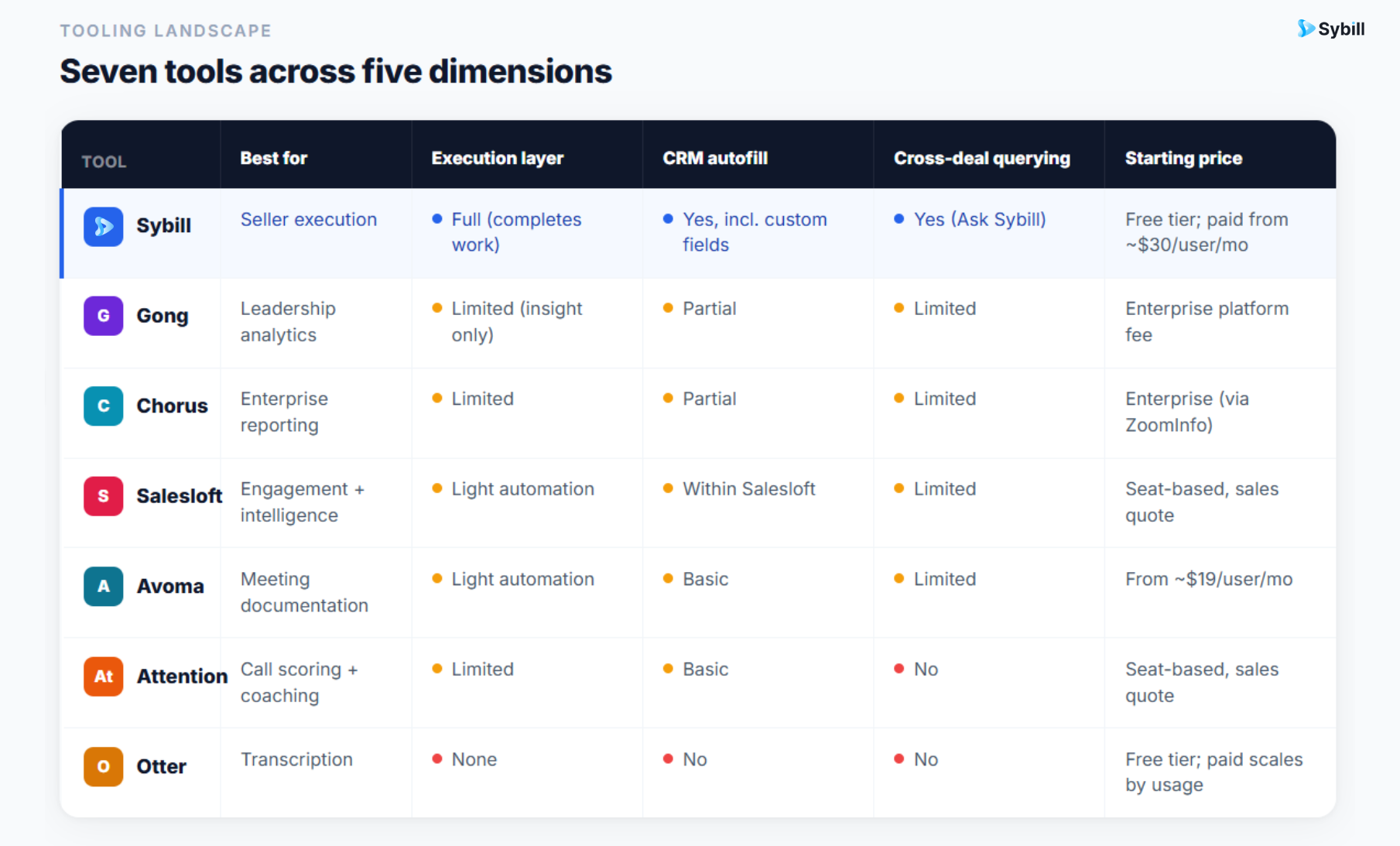
Here is the detail behind the ranking. Each review opens with what the tool is, then where it wins and where it leaves work on the table.
Sybill is an execution-first conversation intelligence platform built for the people actually running deals. Where most tools treat the call as the finish line, Sybill treats it as the starting gun. The moment a call ends, it goes to work.
After every conversation, Sybill produces Magic Summaries organized around buyer intent and next steps, autofills CRM fields including custom and qualification fields, drafts send-ready follow-ups, and completes AI Tasks. Ask Sybill lets anyone interrogate patterns across every deal in plain English. It is the post-conversation execution layer that sits on top of your existing stack rather than trying to replace your CRM or engagement platform.
Get started for free with Sybill and see what a conversation intelligence tool feels like when it finishes the work instead of handing you another to-do list. Get started for free with Sybill
Gong is a revenue intelligence platform optimized for visibility at the top. Its call analytics and forecasting dashboards are the deepest on the market for large organizations, and leadership teams lean on it for pipeline reviews and trend-spotting across hundreds of reps.
Gong surfaces a great deal of insight. What it largely leaves to the rep is the execution: the CRM updates and follow-ups still land on their plate. That is why many teams run both, Gong for the QBR and Sybill for daily execution. See our full Sybill versus Gong comparison, the Sybill vs. Gong page, and Sybill plus Gong for running them together.
Chorus, part of ZoomInfo, is a conversation intelligence tool geared toward enterprise reporting and integration with the ZoomInfo data ecosystem. It captures and analyzes calls well and fits naturally into organizations already invested in that stack.
Like other analytics-first tools, its strength is reporting rather than reducing the rep's post-call workload.
Salesloft is a sales engagement platform with conversation intelligence built in, so calls analyzed inside Salesloft connect directly to its cadences and workflows. For teams already living in Salesloft, that adjacency is convenient.
Its intelligence is solid within the Salesloft world, though it is one feature of a broader engagement suite rather than a dedicated execution layer. Sybill is positioned not as a replacement for engagement platforms but as the intelligence and execution layer on top of them. For teams weighing the engagement category, our Salesloft and Outreach alternatives guide goes deeper.
Avoma is a structured meeting assistant that does a tidy job of capturing calls and producing clean, organized summaries. For teams whose main pain is keeping good records of what was discussed, it is a reliable choice.
Its automation is lighter than an execution-first platform, so more of the post-call follow-through stays manual.
Attention focuses on scoring conversations and surfacing coaching metrics for managers. If your immediate priority is quantifying call quality and giving reps structured feedback, it does that job directly.
Its scope is narrower than a full execution platform, centered on coaching and scoring rather than completing downstream work.
Otter is a transcription-first tool best known for fast, searchable, real-time captions. For meetings where you simply need an accurate written record, it is lightweight and effective.
It is not built for sales execution. There is no CRM autofill, no follow-up drafting, and no cross-deal analysis. It is a transcription utility, and a good one, within those limits.
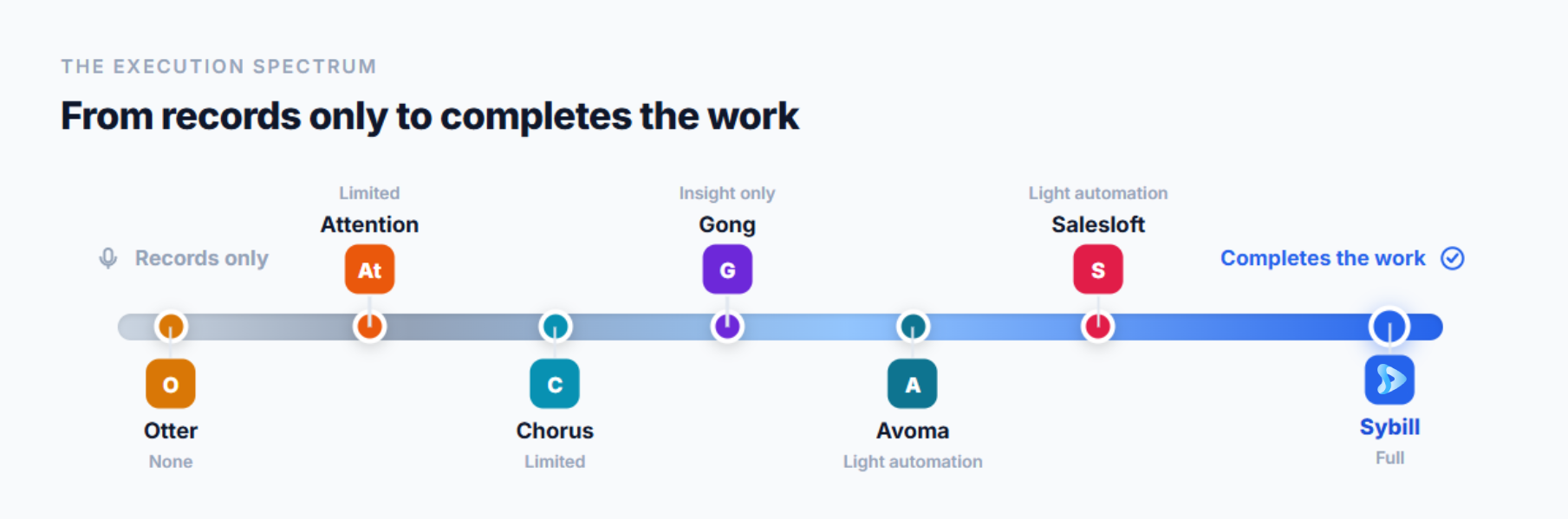
The right conversation intelligence tool depends on your primary problem. Match the tool to the job, not to the longest feature list, and the shortlist gets short fast.
A quick way to self-sort:
For most B2B revenue teams, the bottleneck is execution, not insight, which is why the execution-first option tends to win the head-to-head. If you are deciding between the two most-compared platforms, our Sybill versus Gong breakdown is the next read. And if you are still defining the category for stakeholders, point them to what conversation intelligence is and how it compares to call recording.
There is no single best tool for everyone, because the right pick depends on your primary problem. For seller execution, where the goal is automating post-call work like CRM updates and follow-ups, Sybill leads. For leadership analytics and forecasting across large teams, Gong and Chorus are strong. Match the tool to your bottleneck rather than chasing the longest feature list.
Meeting recorders capture and transcribe calls and stop there. Conversation intelligence tools include recording, then analyze the conversation, extract insights like intent and objections, and act on them by updating the CRM, drafting follow-ups, and surfacing coaching. A recorder gives you a transcript; a conversation intelligence tool gives you analyzed data and, in the best cases, completed work.
Pricing ranges from free tiers to enterprise platform fees. Transcription-first tools and entry plans can start free or around $19 to $30 per user per month, while enterprise analytics platforms carry larger platform-level fees. The more meaningful number is the rep time a tool saves, since an inexpensive tool that leaves manual work intact can cost more in lost hours than a pricier one that automates it.
Most leading tools do. The depth varies, though. Some only log call records, while execution-first platforms like Sybill autofill deal stages, qualification fields, custom fields, and tasks automatically. When evaluating, ask specifically whether the tool fills your custom fields without manual cleanup, since that is where the real time savings live.
Yes, and many teams do. A common pattern pairs a leadership-analytics platform like Gong with an execution-first platform like Sybill, so leadership gets forecasting depth while reps get automated post-call work. Sybill is built to sit on top of an existing stack rather than replace it, which makes this kind of pairing straightforward.
For limited needs, yes. Free tiers are a low-risk way to measure impact before committing budget, and some, including Sybill, offer free recording and transcription. The thing to watch is what the free plan leaves out: if it caps the automation and execution that actually save rep time, treat it as a trial of the value rather than the full value itself.
There is no single best tool for everyone, because the right pick depends on your primary problem. For seller execution, where the goal is automating post-call work like CRM updates and follow-ups, Sybill leads. For leadership analytics and forecasting across large teams, Gong and Chorus are strong. Match the tool to your bottleneck rather than chasing the longest feature list.
Meeting recorders capture and transcribe calls and stop there. Conversation intelligence tools include recording, then analyze the conversation, extract insights like intent and objections, and act on them by updating the CRM, drafting follow-ups, and surfacing coaching. A recorder gives you a transcript; a conversation intelligence tool gives you analyzed data and, in the best cases, completed work.
Pricing ranges from free tiers to enterprise platform fees. Transcription-first tools and entry plans can start free or around $19 to $30 per user per month, while enterprise analytics platforms carry larger platform-level fees. The more meaningful number is the rep time a tool saves, since an inexpensive tool that leaves manual work intact can cost more in lost hours than a pricier one that automates it.





.avif)