Find us at booth #83, join us for a harbor side happy hour, or catch Gorish’s talk.

Sept, 16-18 > Learn more

%20(1).avif)
Mamta Tainwala

May 23, 2026
.png)
Conversation intelligence ROI is the measurable financial return a sales organization earns after investing in AI software that records, transcribes, and analyzes sales conversations. Most B2B sales teams see 5x to 15x return on investment within the first year, driven primarily by recovered rep selling time, higher close rates through better coaching, faster new hire ramp, and improved deal velocity. The specific return depends on your team size, average deal value, current close rate, and how much manual post-call work your reps are doing today.
However, most ROI projections for conversation intelligence software rely on a single inflated metric ("revenue influenced"), ignore implementation costs, and assume 100% adoption from day one. Sales leaders who have been burned by vendor math before have every right to be skeptical.
This guide breaks down how to calculate conversation intelligence ROI honestly, what realistic benchmarks look like at different team sizes, which metrics actually drive returns, and where the math breaks down when vendors are doing the talking instead of your finance team.
Conversation intelligence ROI measures the financial gain your sales team generates from a conversation intelligence platform relative to what you pay for it. It accounts for both direct revenue impact (more deals closed, larger deal sizes) and efficiency gains (time saved on admin, faster onboarding, better coaching throughput).
The distinction matters because most vendors conflate "value" with ROI. A platform might deliver value through better call transcripts. But value only becomes ROI when it translates into measurable dollars: revenue gained, costs avoided, or capacity recovered.
According to Forrester's Total Economic Impact methodology for evaluating sales technology, the strongest ROI signals from conversation intelligence come from three categories. First, productivity recovery, which is the time reps get back when AI handles note-taking, CRM updates, and follow-up drafting. Second, revenue acceleration, which covers close rate improvements, deal size expansion, and pipeline velocity gains driven by better coaching and deal execution. Third, cost avoidance, which includes reduced new hire ramp time, lower attrition from better coaching culture, and fewer forecast surprises from improved pipeline visibility.
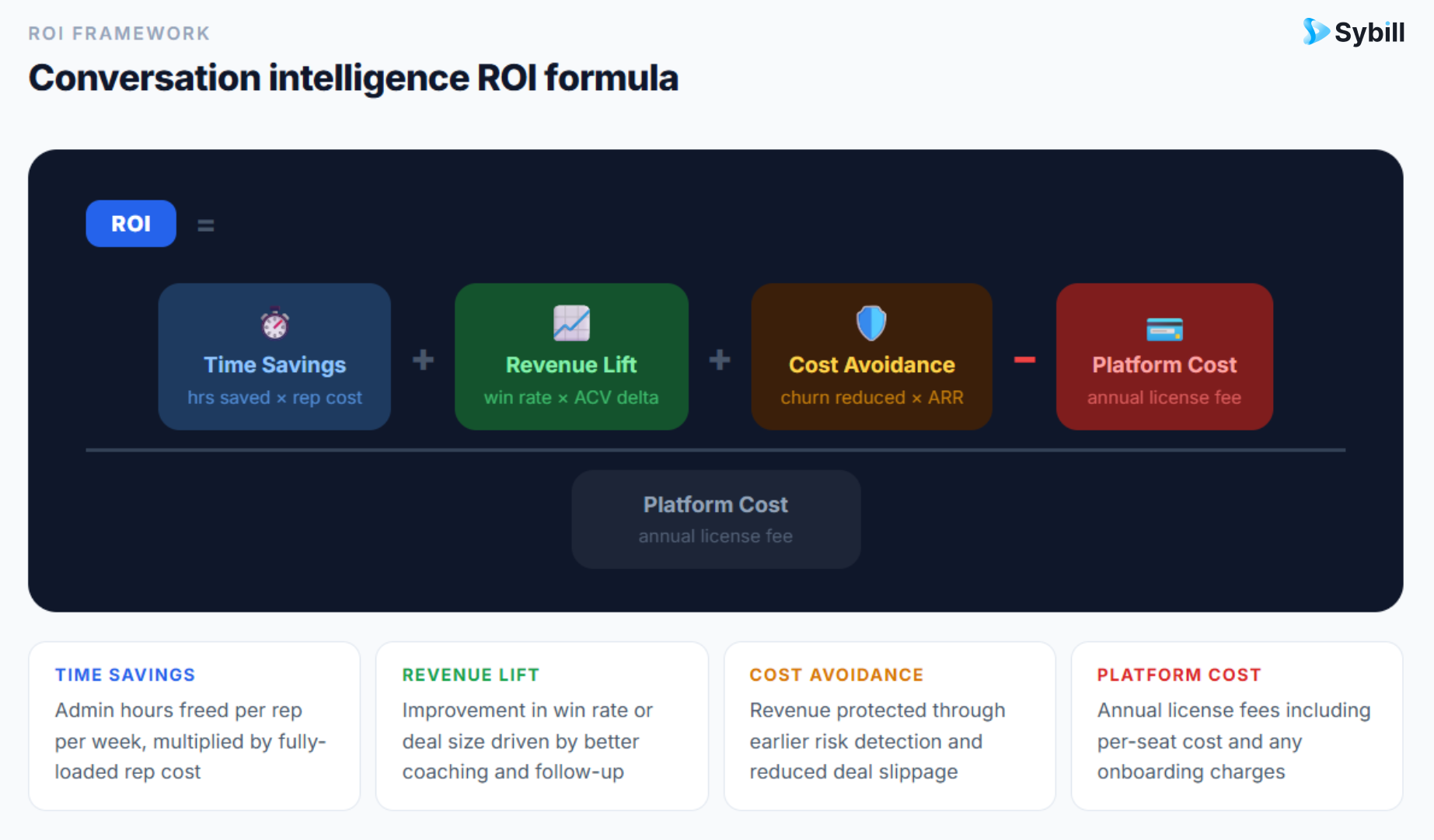
Calculate conversation intelligence ROI using this formula:
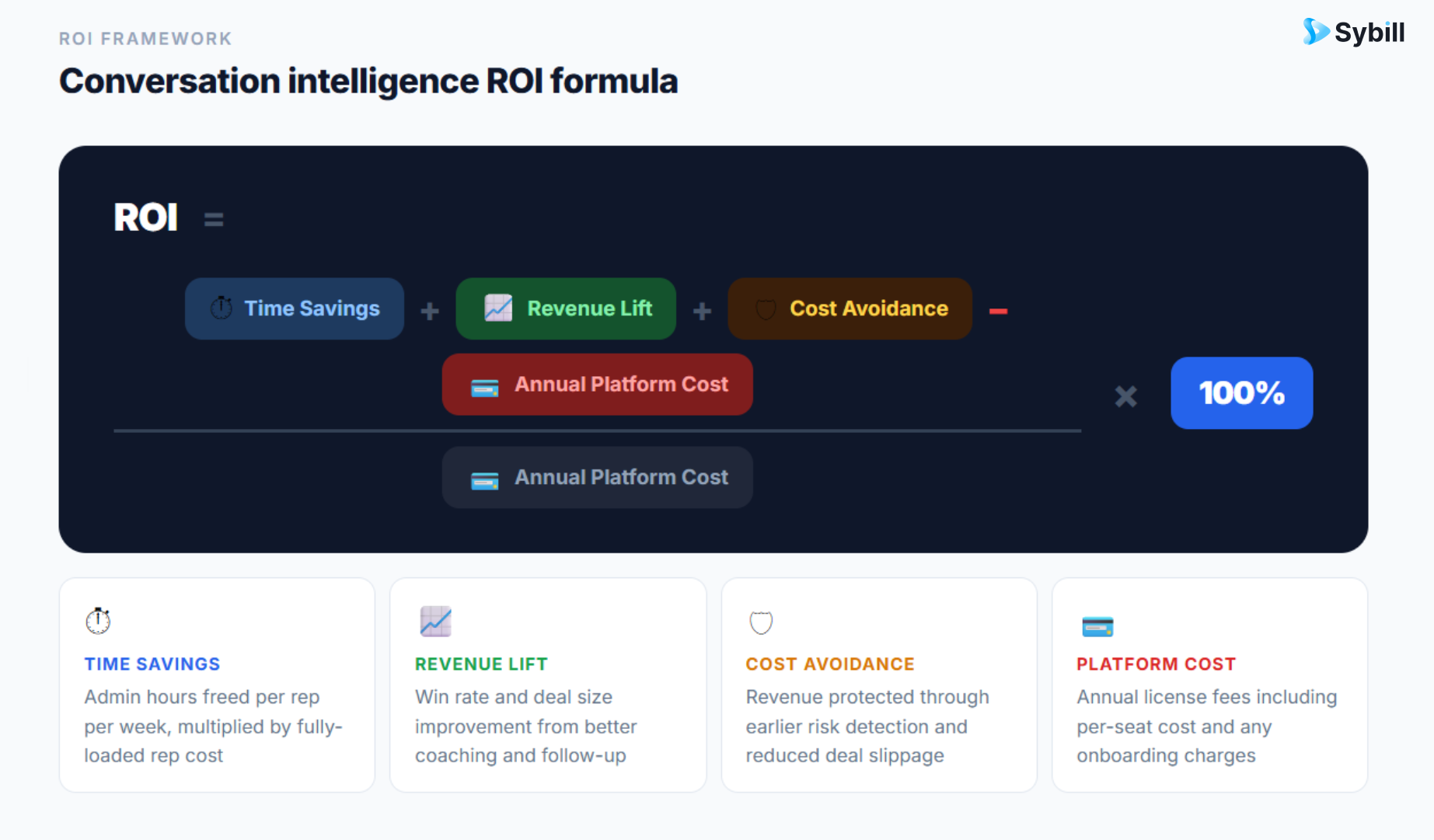
Each variable has a specific measurement method. Here is how to derive them.
Sales reps spend an average of 28% of their week on administrative tasks, according to Salesforce's State of Sales report. For a rep working 45 hours a week, that is roughly 12.6 hours on CRM updates, note-taking, follow-up drafting, meeting prep, and internal reporting.
Conversation intelligence platforms that automate post-call workflows, CRM field updates, and follow-up email generation recover a significant chunk of that time. The conservative estimate across the industry is 5-7 hours/rep/week.
Example: A rep earning $120,000 fully loaded costs roughly $58 per hour. Saving 5 hours per week equals $290 per week, or approximately $15,000/rep/year. That much cost toward more outbound and sales.
Revenue lift from conversation intelligence comes from three mechanisms.
Close rate improvement is the largest driver. CI platforms surface winning behaviors from top performers and make those patterns visible to the rest of the team through coaching insights. Conservative modeling assumes a 3-5% point close rate improvement in year one. For a team closing 20% of qualified opportunities, moving to 24% on $3 million in qualified pipeline generates $120,000 in incremental revenue.
Deal size expansion is the second mechanism. Better discovery questions, objection handling, and multi-stakeholder engagement naturally increase average contract values by 5 to 15%.
Pipeline velocity is the third. Faster follow-ups, earlier risk detection, and more consistent next-step execution compress sales cycles and increase the number of deals a rep can work simultaneously.
Cost avoidance is the ROI component most teams forget to model. It includes reduced new hire ramp time (CI platforms cut onboarding from 6 months to 3 to 4 months by giving new reps access to real winning calls from day one), lower rep attrition from better coaching culture, improved forecast accuracy that prevents end-of-quarter panic hiring or discounting, and fewer compliance incidents from better conversation monitoring.
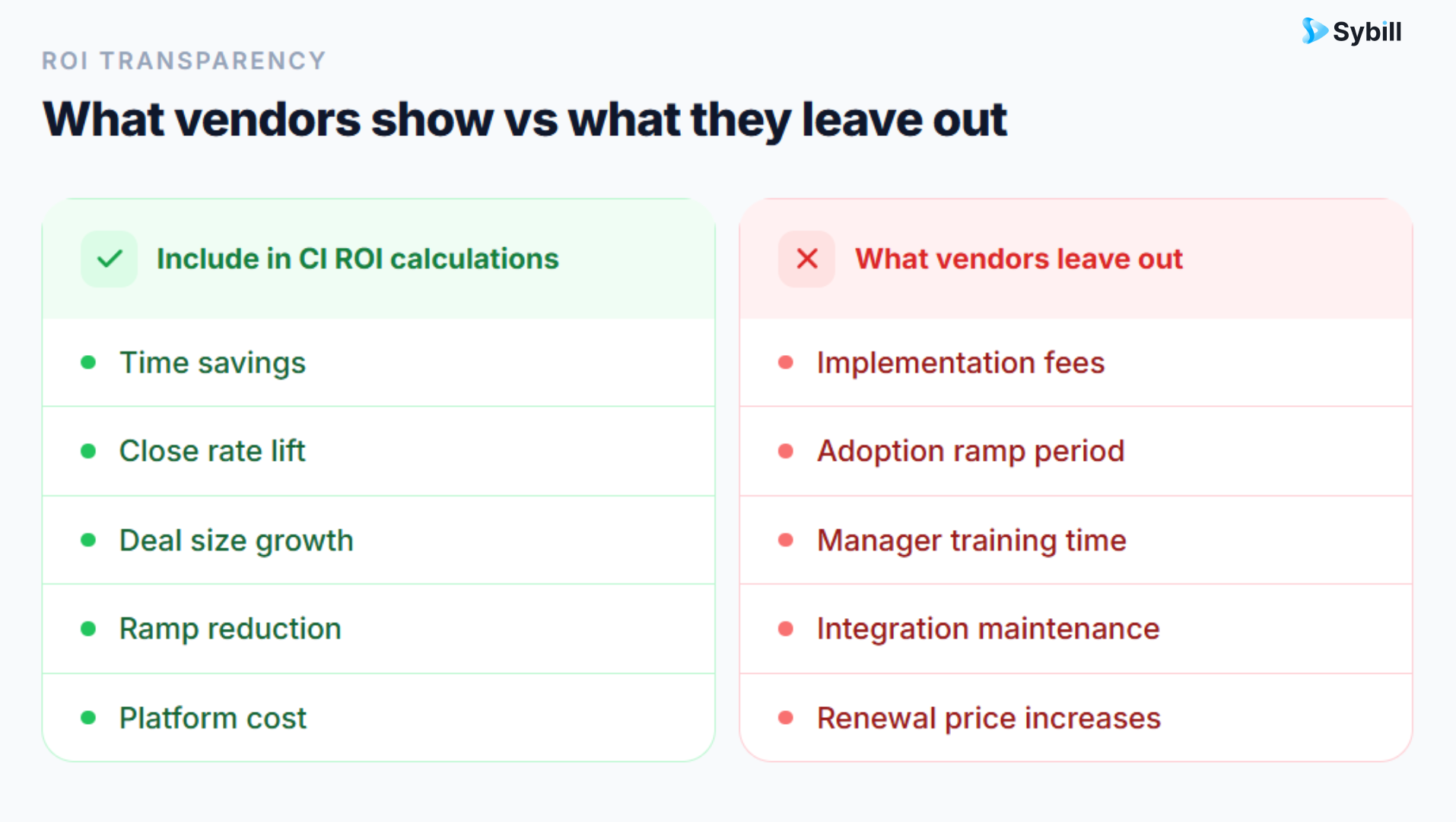
Include everything in the denominator: per-seat licensing, platform fees, implementation costs, integration setup, training time, and any overage fees for recording minutes or storage. Some platforms look cheap per seat but add $5,000 to $15,000 in implementation fees that never appear in the initial quote. Sybill charges $79 per user per month on the Business plan with no implementation fees, no minimum seats, and no annual contract requirement.
The return on conversation intelligence scales differently depending on team size, deal value, and how much manual work your current workflow demands. Here are worked examples at four team sizes, using conservative assumptions: 5-hour weekly time savings per rep, 4% point close rate improvement, $30,000 average deal size, 20% baseline close rate, and 40 qualified opportunities per rep per year.
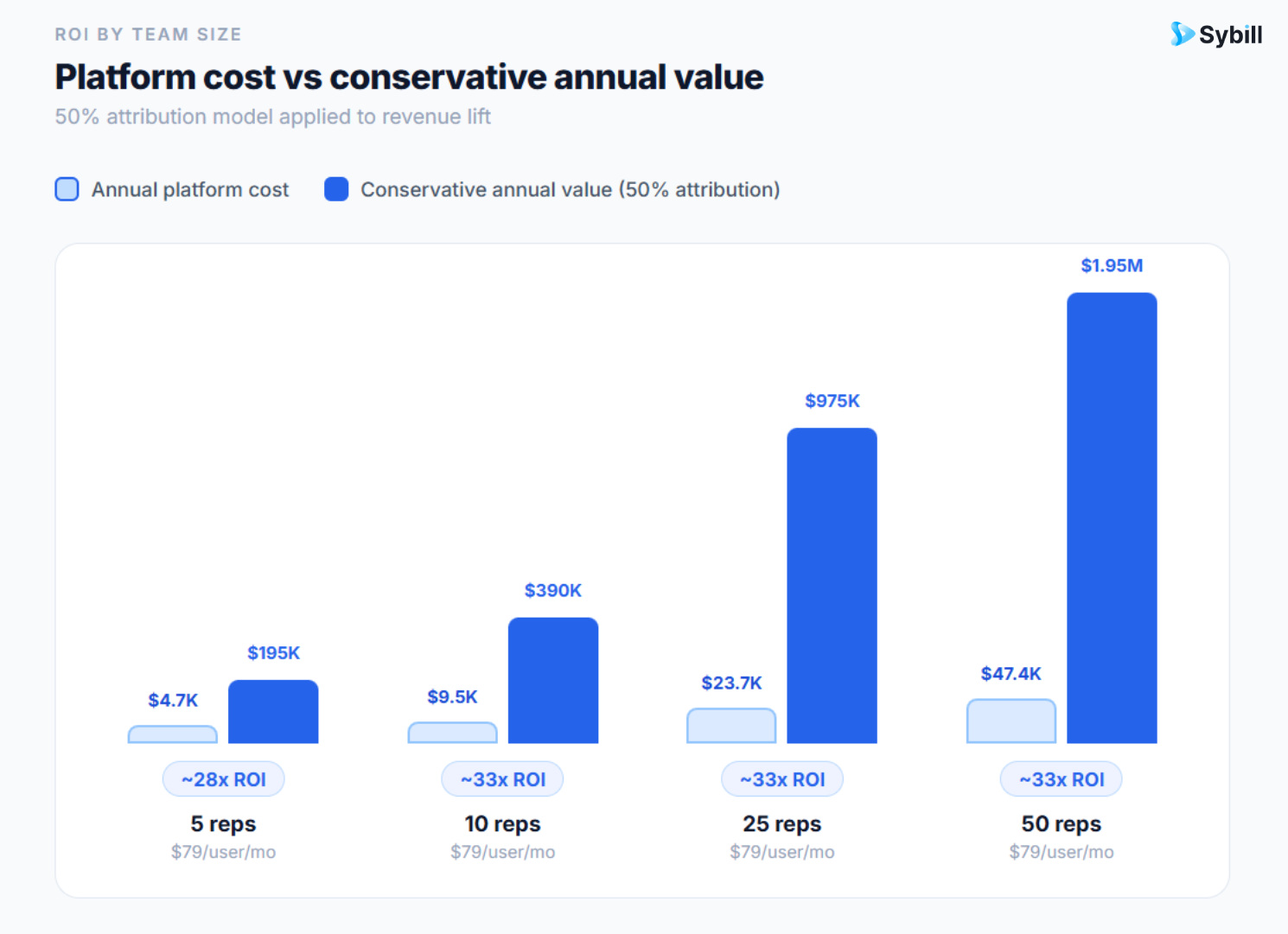
5-rep team: Annual platform cost (Sybill Business at $79/user/month): $4,740. Productivity recovery: $75,000. Revenue lift from close rate improvement (8 additional deals x $30,000): $240,000. Even attributing only 50% of the revenue lift to the platform, the conservative ROI is approximately 28x.
10-rep team: Annual platform cost: $9,480. Productivity recovery: $150,000. Revenue lift (16 additional deals): $480,000. Conservative 50% attribution ROI: approximately 33x.
25-rep team: Annual platform cost: $23,700. Productivity recovery: $375,000. Revenue lift (40 additional deals): $1,200,000. Conservative 50% attribution ROI: approximately 33x.
50-rep team: Annual platform cost: $47,400. Productivity recovery: $750,000. Revenue lift (80 additional deals): $2,400,000. Conservative 50% attribution ROI: approximately 33x.
Two things stand out in these numbers. First, even the productivity recovery alone covers the platform cost multiple times over at every team size. The revenue lift is upside. Second, the ROI percentage stays roughly consistent across team sizes because Sybill's pricing scales linearly. Platforms with mandatory minimums, platform fees, or implementation costs show dramatically worse ROI for smaller teams.
Not all CI metrics matter equally for ROI. These five account for the vast majority of financial return, and each one maps directly to a Sybill capability.
This is the fastest-payback metric and the easiest to measure. Track how many hours per week reps spend on CRM updates, note-taking, follow-up email drafting, and meeting prep before and after deploying conversation intelligence.
Sybill's CRM Autofill populates 30 or more fields after every call and email automatically, including MEDDPICC criteria, next steps, pain points, objections, and custom fields. Magic Summary generates structured call outputs covering outcome, buyer signals, and action items within minutes. AI follow-up emails draft in the rep's own tone, referencing specific details from the conversation.
The combined effect is that reps recover 5 or more hours per week that go directly back into selling time. For a 10-person team, that is 50 hours per week, more than a full-time employee's worth of selling capacity recovered without hiring anyone.
Close rate improvement accounts for 60 to 70% of total conversation intelligence ROI for most teams. The mechanism is straightforward: CI surfaces the specific behaviors that separate your top 20% from your middle 60%, then makes those behaviors coachable.
The behaviors that drive close rate improvement include optimal talk-to-listen ratios (top performers typically maintain 40 to 45% talk time versus 60% or more for average reps), responding to buying signals within the same conversation rather than in a follow-up, addressing objections before the prospect raises them, and booking the next meeting before the current call ends.
Ask Sybill lets managers query across all deals to identify which reps are struggling with specific skills: "Show me calls where discovery depth was below average" or "Which reps are skipping budget qualification?" That kind of cross-deal intelligence turns coaching from anecdotal to systematic.
New sales hires typically take 6 to 9 months to reach full quota attainment. CI platforms compress this by 30 to 50% through three mechanisms.
First, new reps get structured coaching feedback on every single call from day one.
Second, they gain access to a library of real winning calls from top performers in their specific selling environment.
Third, managers can coach new reps more precisely because they have conversation data for every call.
Cutting 2 to 3 months off a 6-month ramp means each new hire starts contributing to pipeline earlier. For a team hiring 4 reps per year, that is 8 to 12 months of accelerated pipeline contribution. At even a conservative $30,000 per rep per month in pipeline generated, the savings compound quickly.
Deals stall for predictable reasons: late follow-ups, missed buyer signals, unaddressed objections, unclear next steps, and stakeholders who were never properly engaged. Conversation intelligence addresses each of these by automating what happens after the call.
Sybill drafts follow-up emails within minutes of a call ending, referencing specific pain points and commitments discussed. It identifies action items automatically and tracks them. Deal intelligence flags at-risk deals based on conversational signals, like declining engagement or repeated objections that go unresolved, before deals go cold.
The result is that pipelines move faster because nothing falls through the cracks. Reps follow up promptly with relevant, personalized messages. Managers intervene on stalled deals before they die. And the entire team operates with better information about where each deal actually stands.
Bad forecasts are expensive. They lead to wrong hiring decisions, misallocated resources, unnecessary discounting at quarter end, and eroded trust between sales leadership and the board. CI improves forecasting by grounding pipeline assessments in conversation evidence rather than rep optimism.
When deal qualification fields like MEDDPICC criteria are auto-populated from actual call data through CRM Autofill, managers can weight pipeline based on verified evidence instead of self-reported stage progression. Teams using structured qualification frameworks supported by CI data report forecast accuracy improvements from the 60 to 70% range to above 85%.
The biggest problem with vendor-supplied ROI projections is not that the numbers are fabricated. It is that they cherry-pick the most flattering assumptions and ignore the costs that eat into actual returns.
"Revenue influenced" is the laziest ROI metric in sales technology. Every tool that touches the sales process can claim to have "influenced" closed revenue. Did the deal close because of the CI platform, or because the rep built a great relationship, or because the product was the right fit, or because the competitor's implementation went badly? Attribution is nearly impossible to isolate in complex B2B sales.
Better approach: focus on efficiency metrics that are directly measurable and attributable. Hours saved per rep per week. Percentage improvement in close rate. Days reduced in sales cycle. Months cut from new hire ramp time. These are metrics your finance team can verify independently.
A CI platform that takes 30 days to implement, 30 days to train your team, and another 30 days to accumulate enough data for meaningful insights has already cost you a quarter of missed targets. That delayed value is a real cost that never appears in vendor ROI calculators.
Sybill deploys in a single day. Connect your calendar, record your first call, and get a structured summary, CRM field updates, and a follow-up email draft before your next meeting starts. No implementation project. No AI training period. No data accumulation phase.
The best CI platform in the world delivers zero ROI if your reps do not use it. Adoption rates for sales technology average 40 to 60% in the first 90 days. Platforms that feel like surveillance tools or that add more work to the rep's day see even lower adoption.
Honest ROI modeling should haircut projections by 30 to 40% to account for partial adoption. The platforms that achieve high adoption are the ones that save reps time immediately and require minimal behavior change. If the first thing a rep experiences after a call is a Magic Summary in their inbox, a CRM update they did not have to write, and a follow-up email they only need to review and send, adoption takes care of itself.
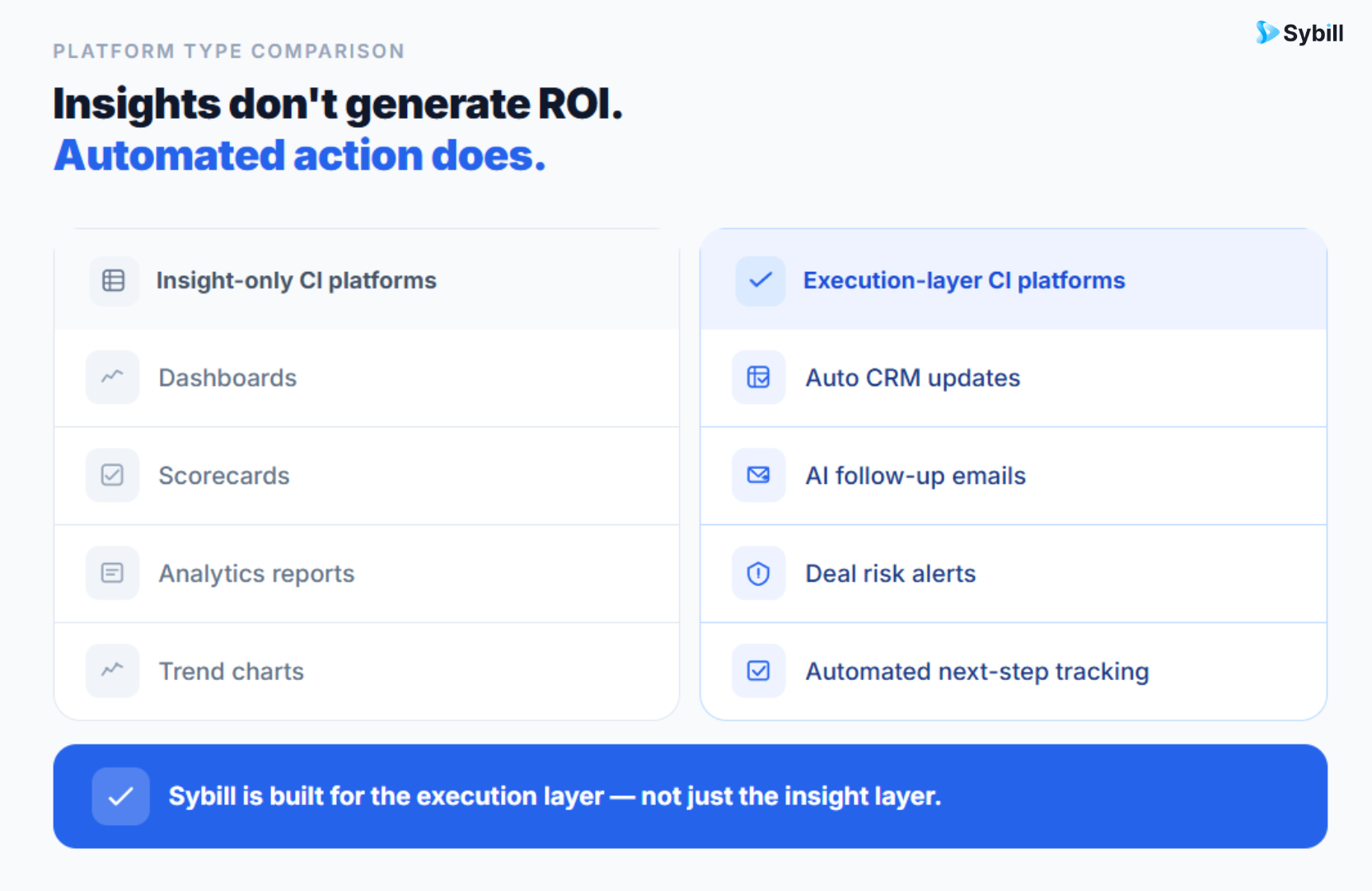
Conversation intelligence platforms that stop at providing insights, analytics dashboards, coaching scorecards, and trend reports are only halfway there. Insights do not generate ROI. Action does.
The follow-up email that writes itself generates ROI. The CRM field that updates itself generates ROI. The next steps that get tracked automatically generate ROI. The deal risk that gets flagged before the deal goes cold generates ROI. This is the fundamental difference between conversation intelligence platforms built for observation and platforms built for execution.
Sales leaders evaluating CI spend are not comparing it against zero. They are comparing it against other ways to invest the same dollars: hiring another rep, expanding a training program, buying a better CRM add-on, or investing in sales engagement software.
Here is how the ROI math stacks up against common alternatives.
Traditional sales training costs $1,500 to $5,000 per rep per program and suffers from a well-documented skill decay problem. Research from the Sales Management Association shows that 84% of sales training content is forgotten within 90 days. CI platforms deliver coaching reinforcement on every single call, indefinitely, at a lower per-rep cost. The ROI of conversation intelligence is structurally superior to periodic training because it replaces one-time interventions with continuous improvement.
Hiring an additional rep costs $150,000 or more per year (salary, benefits, ramp time, management overhead) and takes 6 to 9 months to reach full productivity. Recovering 5 hours per week across a 10-person team with CI gives you the equivalent selling capacity of an additional rep at roughly 6% of the cost.
Sales engagement platforms like Outreach and Salesloft deliver ROI through outbound automation and sequencing. But they do not address the post-conversation execution gap. Teams that combine a sales engagement platform with conversation intelligence see compounding returns because outbound sequences generate conversations and CI makes those conversations more productive.
Conversation intelligence ROI varies meaningfully depending on your sales motion. Understanding where the biggest returns come from for your specific model helps you prioritize which metrics to track and which features to activate first.
High-velocity inside sales (deal sizes under $20,000, cycles under 30 days): The primary ROI driver is rep time recovery. In high-volume environments, every minute saved per call compounds across hundreds of conversations per month. Automated follow-ups and CRM updates deliver the fastest payback. Close rate coaching is a secondary but meaningful driver.
Mid-market sales (deal sizes $20,000 to $100,000, cycles 30 to 90 days): ROI comes from a balanced mix of time recovery, coaching-driven close rate improvement, and deal velocity gains. This is the sweet spot for conversation intelligence because the deals are complex enough to benefit from structured intelligence but high-volume enough for efficiency gains to compound. Sybill's deal workspace and MEDDPICC-aligned CRM Autofill are particularly valuable here.
Enterprise sales (deal sizes above $100,000, cycles 90 days or more): The highest-value ROI metric shifts to forecast accuracy and deal risk detection. When a single deal represents $200,000 or more in ARR, identifying a risk signal two weeks earlier, or avoiding a bad forecast that triggers unnecessary discounting, can justify the entire annual platform cost from one deal.
Field and in-person sales: Until recently, field reps were excluded from conversation intelligence entirely. Sybill's native mobile app now captures in-person meetings through voice recording and delivers the same structured summaries, CRM updates, and follow-up emails that inside sales teams rely on. For organizations with significant field sales activity, this closes a major visibility gap and extends CI ROI to a previously invisible channel.
The denominator in your ROI calculation matters as much as the numerator. A CI platform that delivers identical revenue lift at half the cost produces double the ROI. Here is what the market actually looks like in 2026.
Sybill Business plan costs $79 per user per month with no minimum seat requirements, no annual contract, no implementation fees, and same-day deployment. It includes Magic Summary, CRM Autofill across 30 or more fields, AI follow-up emails, pre-meeting briefs, Ask Sybill cross-deal querying, deal workspace, and coaching insights across both virtual and in-person meetings.
Gong's current pricing structure runs $1,200 to $1,600 per user per year with a 15-seat minimum, mandatory annual contracts, and implementation fees of $5,000 to $15,000. The 2025 pricing restructure unbundled features like forecasting and engagement into paid modules, pushing effective per-user costs to $250 per month or more for bundled packages. Gong contracts include automatic renewal increases of 5 to 15% per year.
For a 10-person team over 12 months: Sybill total cost: $9,480. Gong total cost (conservative): $24,000 or more, before implementation. The same revenue lift produces 2.5x higher ROI with the lower-cost platform.
The fastest way to validate conversation intelligence ROI is not a spreadsheet model. It is recording your next 5 sales calls with Sybill and measuring the time you get back.
No implementation project. No 90-day data accumulation period. No minimum seats. Connect your calendar, take your next call, and see a structured summary, auto-populated CRM fields, and a follow-up email draft before your next meeting starts.
Try Sybill free and see what your pipeline data looks like when it comes from what was actually said, not what was remembered.
Most B2B sales teams see 5x to 15x return on investment within the first year from conversation intelligence. The primary value comes from three sources: recovered rep selling time (5 or more hours per week per rep), close rate improvement (3 to 5% points), and new hire ramp reduction (30 to 50% faster time to productivity). Teams with higher deal values and wider performance gaps between top and average reps see the highest absolute returns.
Productivity ROI, meaning time saved on CRM updates, note-taking, and follow-up drafting, is visible from day one with platforms that require no implementation period. Coaching-driven close rate improvement typically takes 30 to 60 days to become measurable. Pipeline velocity and deal size improvements compound over 60 to 90 days. Full ROI across all metrics generally materializes within one quarter of consistent use.
Use this formula: ROI equals time savings plus revenue lift plus cost avoidance, minus annual platform cost, divided by annual platform cost, multiplied by 100%. Time savings is the dollar value of hours recovered per rep per week. Revenue lift includes incremental closed revenue from close rate improvement and deal size expansion. Cost avoidance covers reduced ramp time, lower attrition, and improved forecast accuracy. Include all platform costs in the denominator: licensing, implementation, integration, and training.
Small teams often see the highest relative ROI because they feel administrative burden more acutely. When each rep manages multiple accounts, every hour spent on manual CRM updates, rewriting notes, or reconstructing context reduces selling time. A 5-rep team using Sybill at $79 per user per month pays $4,740 per year. Recovering 5 hours per week across those 5 reps delivers $75,000 in productivity value, a return that exceeds the platform cost by 15x before any revenue lift is counted.
Traditional sales training programs cost $1,500 to $5,000 per rep per program and suffer from rapid skill decay, with research showing 84% of training content is forgotten within 90 days. Conversation intelligence delivers coaching reinforcement on every call, indefinitely, at a lower per-rep cost. The ROI of CI is structurally superior because it replaces periodic interventions with continuous behavioral improvement that compounds over time rather than decaying.
Track five primary metrics: hours saved per rep per week on administrative tasks, close rate percentage change (measured quarterly), average deal size change, new hire time-to-first-deal and time-to-quota, and sales cycle length. Secondary metrics that indicate ROI trajectory include coaching session frequency and quality, CRM data completeness, forecast accuracy percentage, and rep adoption rate of the platform.
In many cases, yes. Conversation intelligence platforms that include CRM automation, follow-up drafting, and deal intelligence can replace standalone note-taking tools, separate email drafting software, basic sales engagement add-ons, and manual coaching preparation workflows. Sybill specifically replaces the need for a separate AI notetaker, a CRM data entry tool, a follow-up email assistant, and a deal intelligence dashboard, consolidating multiple point solutions into a single platform and reducing total sales tech spend.
Most B2B sales teams see 5x to 15x return on investment within the first year from conversation intelligence. The primary value comes from three sources: recovered rep selling time (5 or more hours per week per rep), close rate improvement (3 to 5% points), and new hire ramp reduction (30 to 50% faster time to productivity). Teams with higher deal values and wider performance gaps between top and average reps see the highest absolute returns.
Productivity ROI, meaning time saved on CRM updates, note-taking, and follow-up drafting, is visible from day one with platforms that require no implementation period. Coaching-driven close rate improvement typically takes 30 to 60 days to become measurable. Pipeline velocity and deal size improvements compound over 60 to 90 days. Full ROI across all metrics generally materializes within one quarter of consistent use.
Use this formula: ROI equals time savings plus revenue lift plus cost avoidance, minus annual platform cost, divided by annual platform cost, multiplied by 100%. Time savings is the dollar value of hours recovered per rep per week. Revenue lift includes incremental closed revenue from close rate improvement and deal size expansion. Cost avoidance covers reduced ramp time, lower attrition, and improved forecast accuracy. Include all platform costs in the denominator: licensing, implementation, integration, and training.