Find us at booth #83, join us for a harbor side happy hour, or catch Gorish’s talk.

Sept, 16-18 > Learn more

%20(1).avif)
Mamta Tainwala

March 31, 2026
Your CRM is lying to you.
Not on purpose. But every half-filled field, every outdated contact, every deal stuck in "Negotiation" since last quarter is a small lie that adds up. When leadership asks for a forecast, they are not getting a forecast. They are getting a best guess built on a foundation of stale data and wishful thinking.
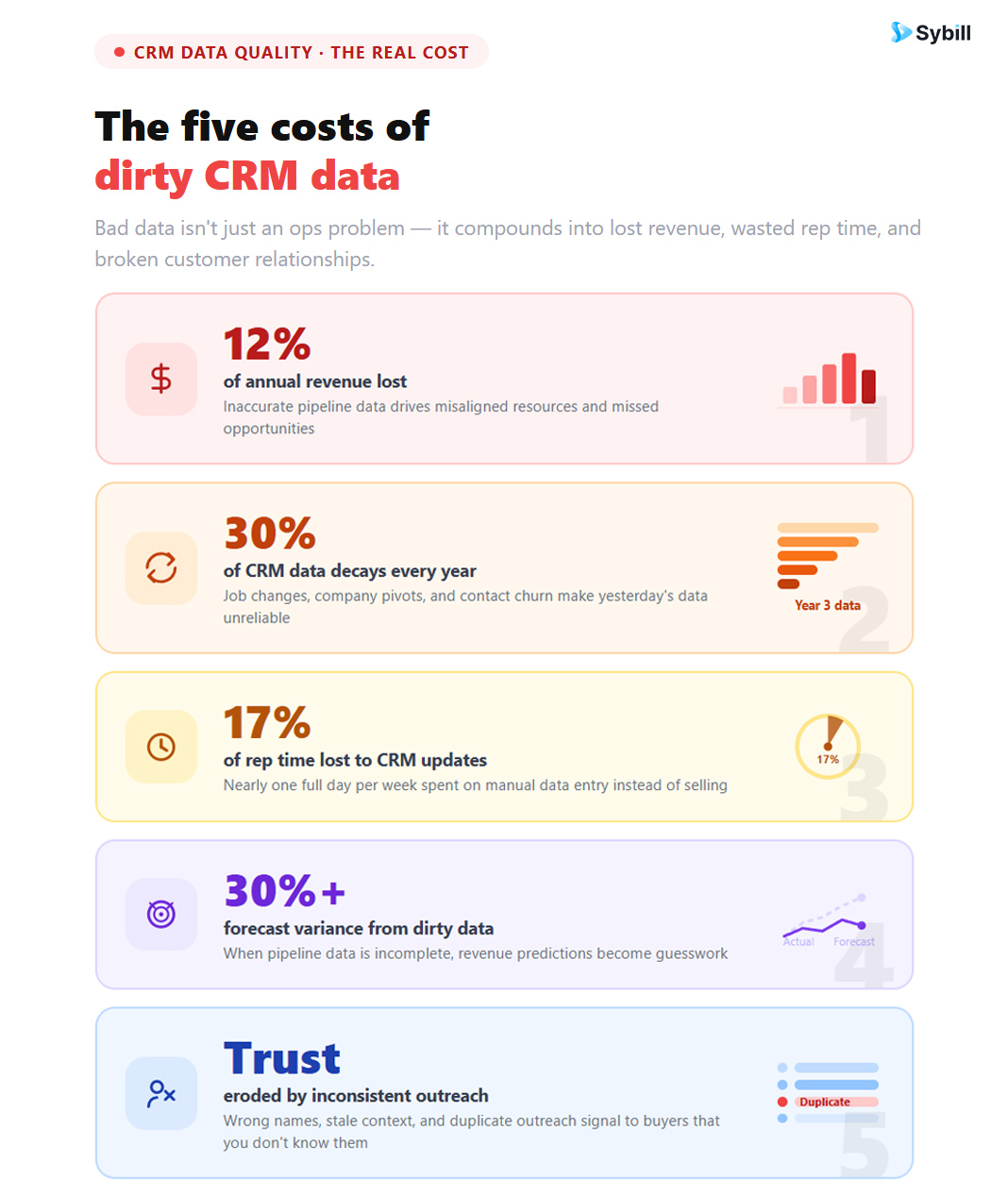
This is the CRM data hygiene problem, and it is costing businesses far more than most sales leaders realize. Research shows that bad CRM data drains roughly 12% of a company's annual revenue. For a $10 million ARR company, that is $1.2 million lost to dirty data every year. Not to deals that were fought and lost, but to deals that never had a chance because the data underneath them was broken.
The good news? CRM hygiene is a solvable problem. And in 2026, it does not require browbeating reps into filling out fields or hiring an army of data entry specialists. CRM automation powered by AI is changing the equation entirely.
This guide covers everything: what CRM data hygiene actually means, why it deteriorates, what it costs when it does, and how to build a system where your CRM stays clean without relying on willpower.
CRM data hygiene is the ongoing practice of keeping your customer relationship management system accurate, complete, consistent, and current. It covers everything from contact records and deal stages to activity logs, qualification fields, and custom properties.
Think of it as the difference between a filing cabinet where every document is labeled, dated, and in the right folder versus one where papers are crammed in at random with coffee stains on half of them. Both cabinets contain information. Only one is useful.
Good CRM hygiene means:
Accuracy. The data reflects reality. If a deal is in "Discovery," discovery is actually happening. If a contact is listed as VP of Sales, they have not quietly moved to a different company six months ago.
Completeness. Required fields are filled with real information, not placeholder text or "TBD." Qualification frameworks like MEDDPICC or BANT are populated after every meaningful conversation, not just before a forecast call.
Consistency. The same data is entered the same way across the entire team. "United States" and "US" and "USA" and "U.S.A." do not all live in the same country field. Job titles follow a standard format. Deal stages mean the same thing to every rep.
Currency. The data is up to date. Contact information, deal status, next steps, and engagement history all reflect what happened this week, not what happened last quarter.
When all four of these pillars are in place, your CRM becomes what it was always supposed to be: a single source of truth that powers accurate forecasts, effective coaching, and confident decision-making across the revenue organization.
Bad CRM data is not an abstract problem. It has concrete, measurable consequences that touch every part of the revenue engine.
The most dangerous thing about dirty data is that its impact is invisible until it is too late. Reps chase leads who left their companies months ago. Managers build forecasts on deals that are already dead but still sitting in "Commit." Marketing runs campaigns against segments that no longer exist.
Industry estimates suggest that roughly 30% of CRM data decays every year. People change jobs, companies get acquired, phone numbers go dead, and email addresses bounce. If you are not actively fighting that decay, nearly a third of your database is misleading you at any given time.
Sales reps already spend less than 30% of their time actually selling. A significant chunk of the remaining 70% goes to administrative tasks, and CRM maintenance is a major piece of that burden. Studies show that reps spend roughly 17% of their work week, nearly a full day, manually updating CRM records.
That is time spent typing notes into fields instead of having conversations with buyers. For a 20-person sales team, the math is brutal: roughly 20 full working days per month consumed by CRM updates across the team. The best CRM automation tools exist specifically to reclaim this time.
A forecast is only as reliable as the data it is built on. When deal stages are outdated, close dates are fictional, and qualification fields are empty, your forecast becomes an exercise in fiction. Every sales leader has experienced the pain of presenting a number to the board that turns out to be 30% off because the pipeline was full of phantom deals and happy ears.
Clean CRM data is the foundation of trustworthy AI-powered sales forecasting. Without it, even the most sophisticated forecasting models are guessing.
Sales managers who try to coach from dirty CRM data end up coaching the wrong things. If the data says a rep has 15 deals in pipeline but seven of them are dead weight, the coaching conversation starts from a false premise. Effective sales coaching requires managers to see what is actually happening in each deal, which is impossible when the CRM is full of noise.
When a rep calls a prospect using the wrong name, references an outdated pain point, or sends a follow-up that contradicts what was discussed on the last call, trust erodes. Clean CRM data is not just an internal operations issue. It directly affects how buyers experience your brand.
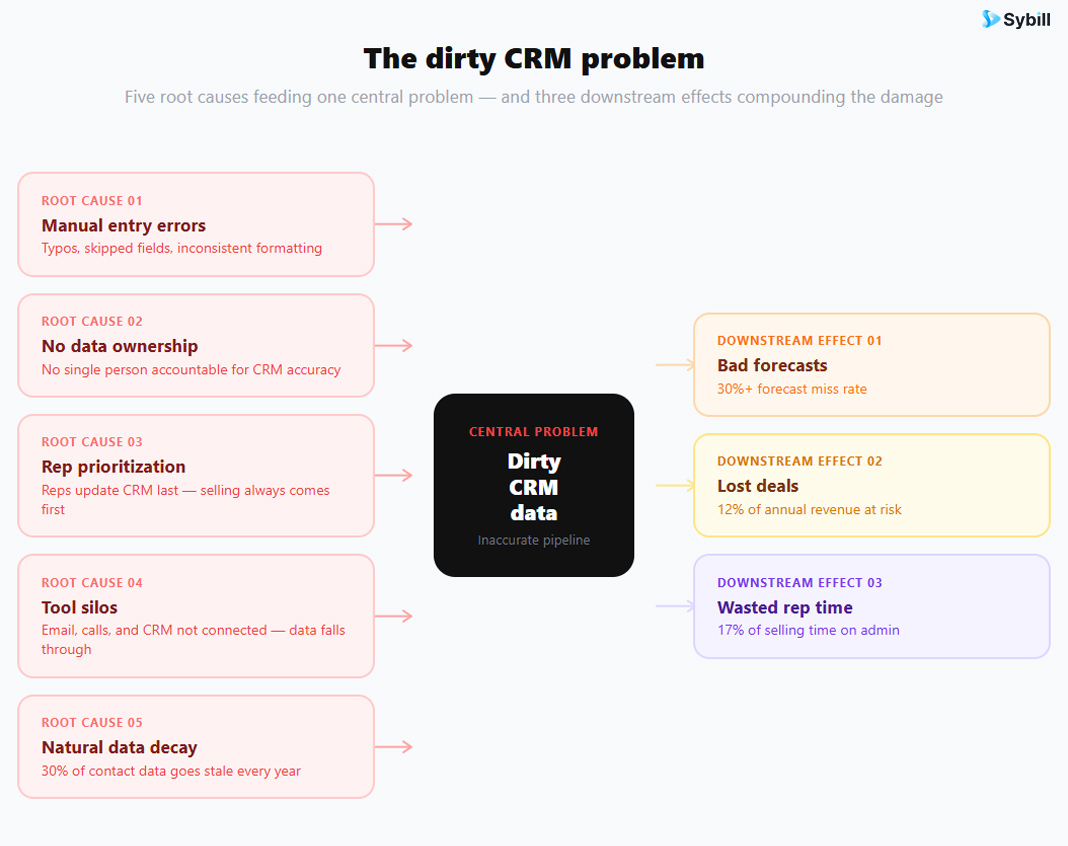
It is not just lazy reps. The default narrative is that CRM hygiene fails because reps are lazy. That is unfair and inaccurate. The real causes are systemic, and until you address them, no amount of nagging will fix the problem.
Humans make mistakes when entering data manually. Partial names, misspelled companies, wrong phone numbers, inconsistent formatting. When a rep is rushing between back-to-back calls and trying to log notes from memory, errors are inevitable. The issue is not carelessness. It is that manual data entry does not scale.
When data quality is everyone's responsibility, it is no one's responsibility. Sales assumes marketing will clean records before handoff. Marketing assumes RevOps will standardize field formats. RevOps assumes reps will enter data correctly in the first place. Meanwhile, dirty records pile up because no single team is accountable.
This is rational behavior, not a character flaw. A rep who has a choice between updating 15 CRM fields or preparing for their next discovery call will choose the discovery call every time. And they should. The problem is the system that forces that choice, not the rep who makes it.
Most sales teams use between five and eight different tools daily: CRM, email, calendar, conversation intelligence, prospecting platform, communication apps, and more. When these tools are not properly synced, data lives in silos. A conversation that happened on a call never makes it to the CRM. An email chain with critical deal context sits in someone's inbox. The CRM shows one version of reality while the actual deal lives elsewhere.
Even in a perfectly maintained CRM, data decays on its own. The average B2B contact changes jobs roughly every 18 months. Companies get acquired, restructured, or shut down. Stakeholders rotate. If you built a lead list six months ago, a significant portion of it is already outdated. Without active enrichment and validation, decay wins by default.
Fixing CRM hygiene requires a system, not a one-time cleanup sprint. Here is a practical framework organized by frequency.
Validate new records at the point of entry. Use required fields, dropdown menus instead of free-text fields, and format validation (especially for emails and phone numbers) to catch errors before they enter the system. The cheapest fix is the one that happens before bad data gets in.
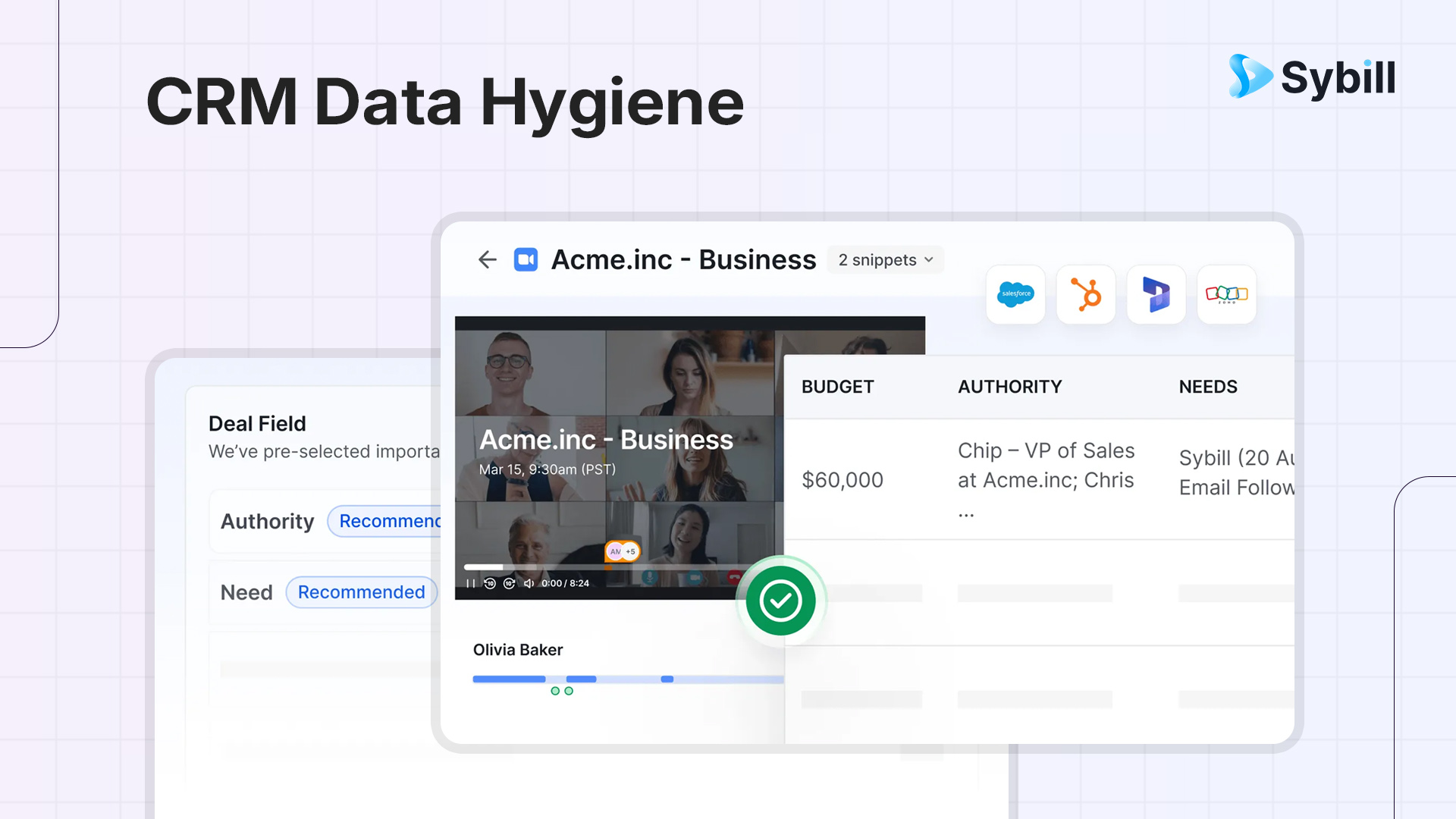
Let AI handle post-call updates. After every sales call or meeting, Sybill's CRM Autofill automatically extracts deal stage, next steps, pain points, objections, stakeholders, MEDDPICC fields, and more from the conversation. The data flows directly into the correct CRM fields without the rep lifting a finger. This is not activity capture (logging that something happened); this is intelligent extraction of what was said, decided, and committed.
Run pipeline reviews with real data. Weekly pipeline reviews should be grounded in accurate, current CRM data. When the CRM is reliably updated after every conversation, the review can focus on strategy and coaching instead of interrogating reps about whether their data is current.
Check for stale deals. Any deal that has not had activity logged in 14+ days deserves scrutiny. Is it really alive, or is it taking up pipeline space and inflating your forecast? Flag stale deals automatically and require reps to either update them or move them out.
Merge duplicates. Run a deduplication pass across contacts, accounts, and opportunities. Even with good entry practices, duplicates creep in through form submissions, list imports, and multi-channel touchpoints.
Audit field completion rates. Track what percentage of records have key fields filled: qualification criteria, next steps, decision-maker info, close date. If completion rates are dropping, it signals either a process problem or a tool problem. With Sybill's 100% autofill rate, this metric largely takes care of itself.
Archive dead records. Contacts who have bounced, leads that went cold 90+ days ago, and opportunities that were lost six months back should be archived, not deleted. Archiving keeps your active database focused while preserving historical data for analysis.
Enrich and validate contact data. Use enrichment tools to update job titles, company information, and contact details across your database. Cross-reference against current data sources to catch the natural 30% annual decay before it compounds.
Review and update data governance rules. What fields are required? What naming conventions apply? Are the rules still aligned with how your team actually sells? Governance should evolve with your sales process, not fossilize.
Most CRM hygiene guides end with some version of "train your reps better" and "enforce data entry standards." That advice is not wrong. It is just insufficient. It treats the symptoms while ignoring the root cause: the CRM requires too much manual effort.
CRM automation solves the problem at the source by removing humans from the data entry loop. Here is what that looks like in practice.
Instead of relying on reps to remember what happened on a call and manually type it into Salesforce or HubSpot, Sybill listens to the conversation and automatically extracts structured data. After every call, Sybill populates:
Deal stage, close dates, and next steps. Qualification fields (MEDDPICC, BANT, custom frameworks). Pain points, objections, and competitor mentions. Stakeholder roles and buying committee members. Budget signals and timeline indicators.
This is not a generic transcript dump. Sybill writes clean, human-sounding entries that read like a thoughtful rep wrote them, not a bot. RevOps can actually filter and report on these fields because they are structured, consistent, and complete. Learn more about how this works in our deep dive on the new CRM Autofill.
CRM data is most valuable when it is fresh. A deal signal captured and logged within minutes of a call can trigger a timely follow-up, an alert to a manager, or an automated workflow. The same signal logged three days later (if it gets logged at all) has already lost most of its value.
Sybill updates CRM fields immediately after each interaction, keeping the system current without requiring the rep to context-switch from selling to typing. This is what modern sales pipeline management looks like: a pipeline that reflects what is actually happening, in near real-time.
When AI fills CRM fields, it follows the same rules every time. There is no variation in how deal stages are named, no creative abbreviations in job title fields, no inconsistency in how next steps are phrased. The standardization that data governance policies try to enforce through training and compliance happens automatically.
This consistency compounds across the team. When every rep's data looks the same, reporting becomes reliable. Forecasts become trustworthy. And AI-powered coaching can draw accurate patterns across reps and deals because the underlying data is clean.
Clean CRM data is not just a RevOps concern. It impacts every role in the revenue organization differently.
Clean data means less time on admin and more time selling. When Sybill automates CRM updates, AEs save an average of 5 to 6 hours per week. That is time reclaimed for pipeline building, deal preparation, and buyer conversations. The follow-up emails Sybill drafts are grounded in accurate CRM context, which means they are relevant, timely, and personalized without extra effort.
Clean data makes coaching actionable. Instead of spending 1:1 meetings interrogating reps about deal status, managers can walk in with reliable data and coach on strategy, skill gaps, and deal risk. Ask Sybill lets managers query their pipeline with questions like "Which deals have no confirmed next steps?" or "Where is this rep consistently losing on pricing?" and get instant, evidence-backed answers.
This is where clean data has the most downstream impact. RevOps teams exist to make the revenue engine efficient, and they cannot do that with unreliable data. When CRM fields are populated automatically with structured, consistent information, RevOps can build reliable reports, accurate territory models, and meaningful routing rules without spending half their time on data cleanup. Our RevOps page details how Sybill solves this specifically.
Clean CRM data means trustworthy forecasts. Leadership decisions about headcount, budget, market strategy, and board reporting all depend on accurate pipeline data. When the CRM reflects reality, leadership can focus on strategy instead of questioning whether the numbers are real.
Best practices only matter if they survive contact with real sales teams. Here are the ones that actually work.
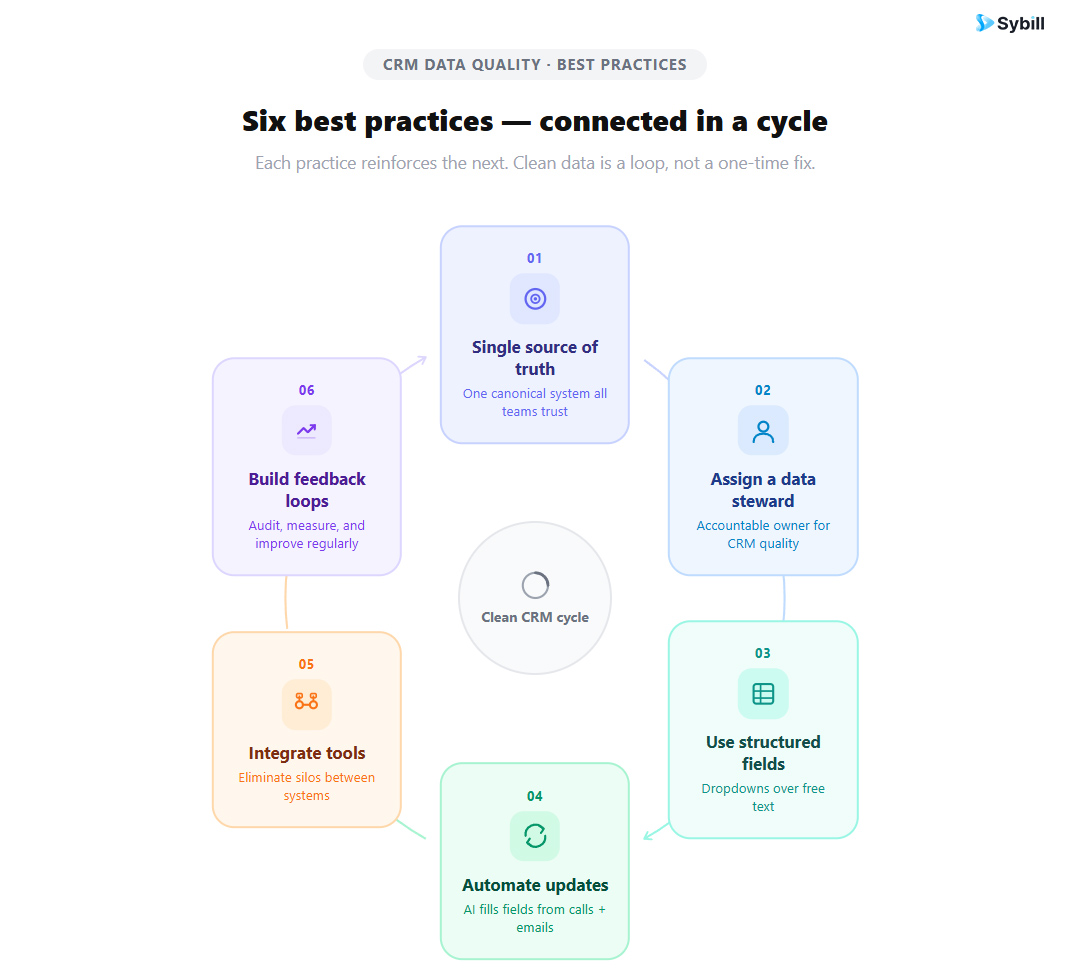
If your team stores deal context in spreadsheets, Slack threads, email chains, and personal notes outside the CRM, your CRM will never be clean. Consolidate. Every meaningful piece of deal information should live in the CRM, and tools like Sybill make this practical by automatically routing call summaries, follow-up context, and deal insights into the right CRM fields and records.
Someone needs to own data quality. This is typically a RevOps role, but the key is that one person (or team) is accountable for governance, audits, and process enforcement. Without ownership, hygiene degrades because accountability is diffused.
Free-text fields are where consistency goes to die. Wherever possible, replace free-text with structured inputs: dropdowns, picklists, checkboxes, and standardized formats. This applies to deal stages, loss reasons, competitor fields, lead sources, and any other field where you need reportable data.
The reason reps resist CRM updates is that it feels like a separate job layered on top of their actual job. The solution is to make CRM updates a byproduct of selling, not an add-on. When Sybill updates the CRM after every call, the rep does not have a "CRM update" task on their to-do list. The update happens because the selling happened. That is the mental model shift that makes hygiene sustainable.
Your CRM, conversation intelligence platform, email, calendar, and communication tools should all feed into a unified data model. When tools are integrated, data flows automatically and consistently. When they are siloed, humans become the integration layer, and humans are unreliable integration layers.
Track hygiene metrics (field completion rates, data freshness, duplicate count) and share them with the team. When reps can see that their data quality is improving and that it is making coaching and forecasting better, compliance becomes intrinsic rather than enforced.
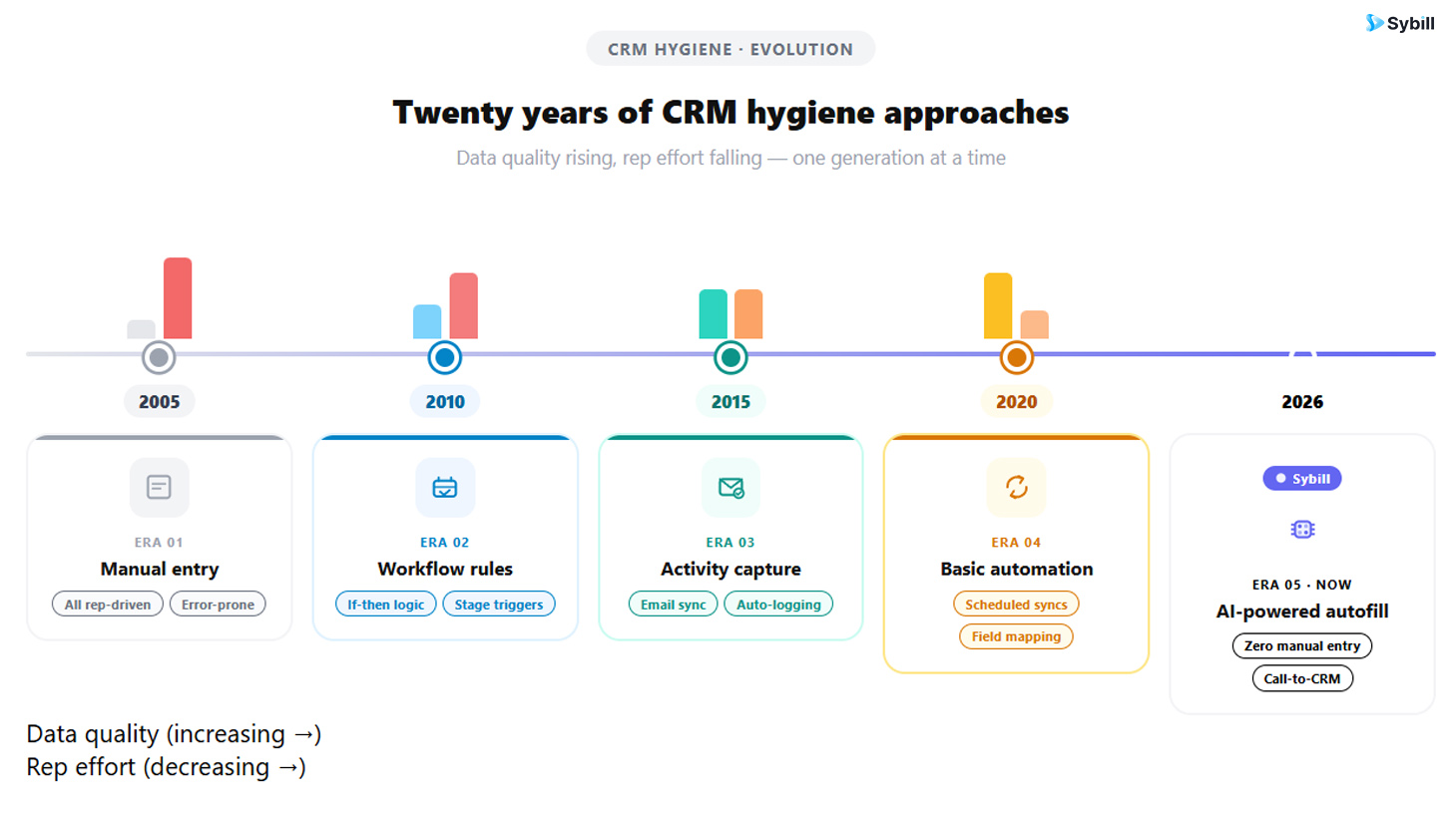
CRM hygiene has been a problem since CRMs were invented. What is different now is that AI has made the solution scalable.
Before AI, clean CRM data required one of two things: disciplined reps who consistently updated every field (rare), or dedicated data entry staff who transcribed information from calls and emails into the CRM (expensive). Neither approach scaled.
AI-powered tools like Sybill change the economics. They listen to every conversation, extract structured insights, and write them into the CRM automatically. The cost per update approaches zero. The consistency is near-perfect. And the accuracy improves over time as the AI learns your team's terminology, deal stages, and qualification frameworks.
This is why the competitive gap between teams with clean CRM data and teams without it is widening. Teams using AI-driven CRM automation are not just saving time on admin. They are making better coaching decisions, running more accurate forecasts, and responding to deal signals faster. The compound effect of clean data across the entire revenue organization is substantial.
For teams that use Salesforce, HubSpot, Zoho, or Dynamics 365, Sybill integrates natively and starts populating fields from day one. Setup takes less than 30 minutes, and most teams report seeing value within the first week.
What is CRM data hygiene?
CRM data hygiene is the ongoing process of maintaining accurate, complete, consistent, and current data in your customer relationship management system. It includes practices like removing duplicates, validating contact information, standardizing field formats, archiving stale records, and ensuring that deal data reflects reality. Without good hygiene, CRM data decays at a rate of roughly 30% per year, which undermines forecasting, coaching, and pipeline management.
Why does CRM data get dirty?
The most common causes are manual data entry errors, lack of clear data ownership across teams, reps prioritizing selling over admin tasks, tool fragmentation that creates data silos, and the natural decay of contact information as people change jobs and companies evolve. The root cause in most organizations is that CRM maintenance requires too much manual effort from people whose primary job is to sell, not to enter data.
How does bad CRM data affect sales forecasting?
Inaccurate CRM data leads directly to inaccurate forecasts. When deal stages are outdated, close dates are fictional, and qualification fields are empty, any forecast built on that data will miss the mark. Research suggests that companies with poor data quality lose more than 10% of annual revenue due to decisions made on unreliable information. Clean data is the foundation of trustworthy forecasting, whether you use pipeline math, weighted probability, or AI-driven models.
What is the difference between CRM data hygiene and CRM automation?
CRM data hygiene is the goal: keeping your data clean, accurate, and useful. CRM automation is the means: using technology to achieve and maintain that goal without relying on manual effort. Automation tools like Sybill's CRM Autofill populate fields automatically after every call and email, which eliminates the primary source of dirty data (manual entry) and ensures consistency across the team.
How often should you audit CRM data?
A practical cadence includes daily validation at the point of entry, weekly pipeline reviews to catch stale deals, monthly deduplication and field completion audits, and quarterly deep cleans that include data enrichment and governance rule updates. The exact frequency depends on your team size and deal volume, but consistency matters more than intensity. Teams that audit monthly outperform teams that do an annual cleanup sprint.
Can AI completely replace manual CRM updates?
For the vast majority of CRM fields, yes. Sybill achieves a 100% autofill rate on supported fields, including deal stage, close date, next steps, qualification criteria, pain points, objections, and stakeholder information. There will always be edge cases where a rep needs to add context manually, but the goal is to make manual CRM updates the exception rather than the rule. When AI handles 90%+ of CRM data entry, hygiene becomes a byproduct of selling rather than a separate task.
What tools help with CRM data hygiene?
At a minimum, you need your CRM's native validation and deduplication features. For enrichment, tools like ZoomInfo and Clearbit keep contact data current. For the highest-impact improvement, an AI-powered CRM automation tool like Sybill eliminates the root cause of dirty data by automatically extracting structured insights from every conversation and writing them into the correct CRM fields. The combination of automation, enrichment, and governance creates a self-sustaining hygiene system.
The irony of CRM systems is that they were built to make selling easier, but for most teams, they became one more chore that makes selling harder. Reps resent the admin burden. Managers distrust the data. RevOps spends more time policing hygiene than building strategy.
It does not have to be this way.
When CRM data flows automatically from every conversation into every field, the CRM transforms from a burden into an asset. Forecasts get more accurate. Coaching gets more targeted. Deals move faster because follow-ups are timely and context-rich. And reps get to spend their time doing what they were hired to do: sell.
Sybill makes this real. It captures the conversation, extracts the insights, fills the fields, drafts the follow-up, and keeps the entire revenue organization working from the same clean, current data set.
Get started for free with Sybill and see what happens when your CRM finally tells the truth.
CRM data hygiene is the ongoing process of maintaining accurate, complete, consistent, and current data in your customer relationship management system. It includes practices like removing duplicates, validating contact information, standardizing field formats, archiving stale records, and ensuring that deal data reflects reality. Without good hygiene, CRM data decays at a rate of roughly 30% per year, which undermines forecasting, coaching, and pipeline management.
The most common causes are manual data entry errors, lack of clear data ownership across teams, reps prioritizing selling over admin tasks, tool fragmentation that creates data silos, and the natural decay of contact information as people change jobs and companies evolve. The root cause in most organizations is that CRM maintenance requires too much manual effort from people whose primary job is to sell, not to enter data.
Inaccurate CRM data leads directly to inaccurate forecasts. When deal stages are outdated, close dates are fictional, and qualification fields are empty, any forecast built on that data will miss the mark. Research suggests that companies with poor data quality lose more than 10% of annual revenue due to decisions made on unreliable information. Clean data is the foundation of trustworthy forecasting, whether you use pipeline math, weighted probability, or AI-driven models.