Find us at booth #83, join us for a harbor side happy hour, or catch Gorish’s talk.

Sept, 16-18 > Learn more

%20(1).avif)
Mamta Tainwala

March 27, 2026
There is a version of this comparison where you just look at the pricing table and make your decision in 30 seconds. Zoho CRM starts at $14 per user per month. Salesforce starts at $25 per user per month. Zoho wins on price, move on.
But that version of the comparison misses everything that actually matters when your company is betting its revenue pipeline on one of these platforms. It misses what each CRM does to your rep's Tuesday afternoon. It misses what happens to your forecast accuracy at quarter end. It misses the features locked behind higher tiers, the implementation costs that never appear on the pricing page, and the question nobody asks: what does your CRM data actually look like six months after go-live?
This guide covers all of it. Zoho CRM and Salesforce are both serious platforms with genuine strengths and real limitations. Which one is right for your team depends on factors that a pricing comparison alone cannot answer.
Zoho Corporation was founded in 1996 in India and launched Zoho CRM in 2005. It has since grown into one of the most feature-rich CRM platforms available at any price point, and it sits inside a broader ecosystem of 45-plus Zoho applications covering accounting, HR, marketing, project management, helpdesk, and more.
Zoho CRM is recognized as a Visionary in Gartner's Magic Quadrant, which is a meaningful designation for a platform that consistently outprices most of its competition. Its AI assistant, Zia, handles lead and deal predictions, anomaly detection in pipeline data, email sentiment analysis, best-time-to-contact recommendations, and competitor mention flagging inside email threads. Its Canvas feature lets teams build fully custom interface views without writing a line of code.
Zoho CRM's pricing runs from a free plan for up to three users, through Standard at $14/user/month, Professional at $23/user/month, Enterprise at $40/user/month, and Ultimate at $52/user/month. At virtually every tier, you get more included features per dollar than any direct competitor.
Best for: SMBs, budget-conscious mid-market teams, companies already using Zoho products, and organizations that need deep customization without enterprise pricing.
Founded in 1999, Salesforce created the cloud CRM category and controls roughly 23.8% of the global CRM market today. More than 80% of Fortune 500 companies run on it. Salesforce Sales Cloud is the core CRM offering, with a supporting ecosystem of tools including Einstein AI, Agentforce for autonomous AI agents, Pardot for marketing automation, Slack for collaboration, and an AppExchange marketplace with over 7,000 third-party applications.
Salesforce's defining strength is configurability. You can model virtually any business process inside it, connect it to virtually any external system, and build virtually any custom workflow. For large enterprises with complex, multi-department revenue operations, that flexibility pays off. The tradeoff is cost and complexity. Implementation typically requires certified consultants. Most meaningful features are gated behind mid-tier or enterprise plans. And the gap between the advertised $25/user/month entry price and the real annual cost for a well-configured enterprise deployment is one of the widest in software.
Best for: Mid-market to enterprise companies with complex, customized sales processes, dedicated Salesforce administrators, and budgets that support sustained technical investment.
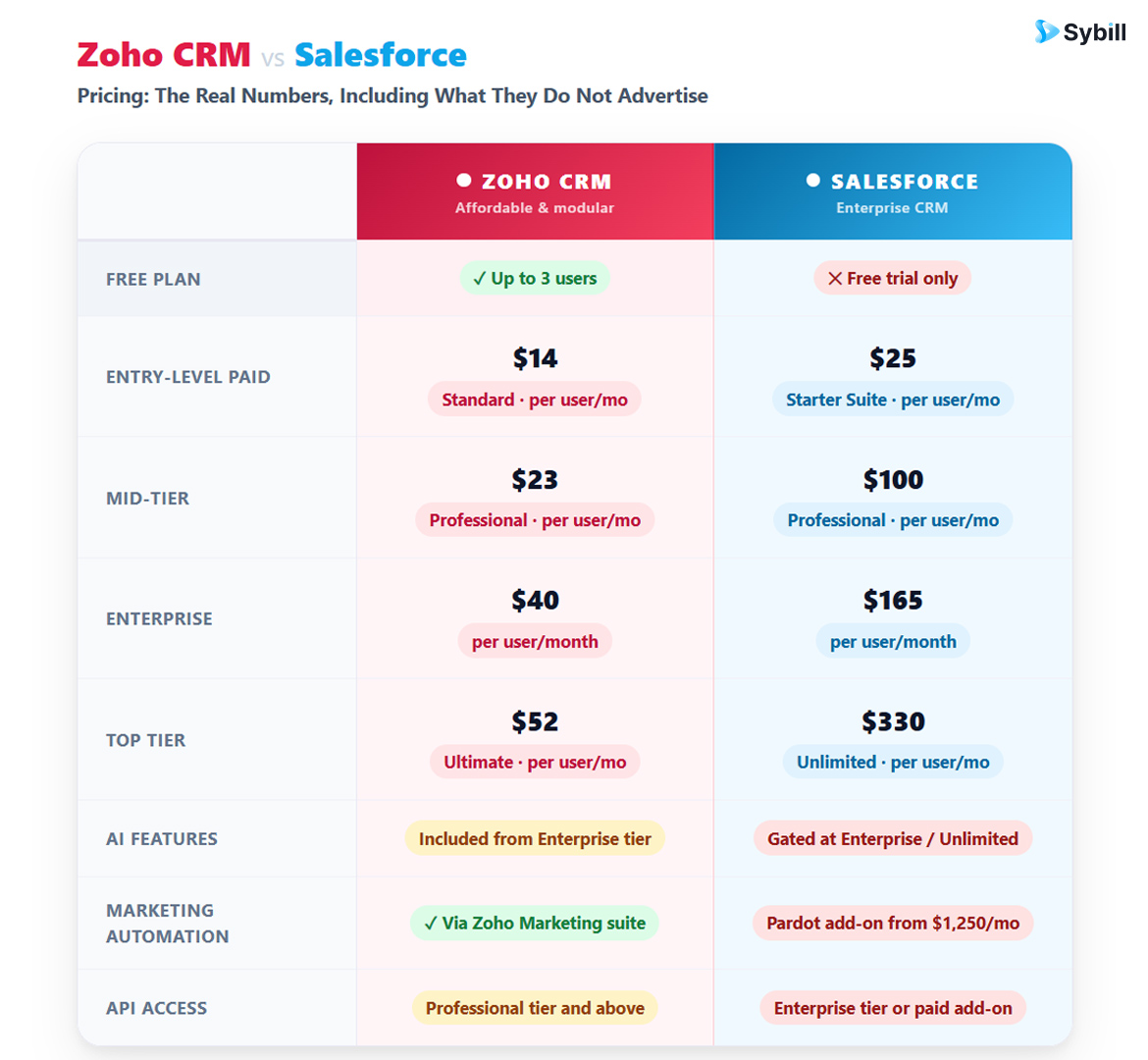
The price gap between Zoho CRM and Salesforce is not subtle. A 10-person sales team on Zoho CRM Professional pays approximately $2,760 per year. The same team on Salesforce Professional pays approximately $12,000 per year in license fees alone, before implementation and add-ons.
Where this comparison gets more nuanced is at the feature level. Salesforce's Professional plan includes more out-of-the-box CRM functionality at that price point than Zoho's Standard tier, even though Zoho Standard is much cheaper. But when you step up to Zoho Enterprise ($40/user/month), you get AI-powered features through Zia, advanced automation, custom modules, and a feature set that genuinely rivals Salesforce Professional at less than a quarter of the price.
The other hidden cost to factor in: Salesforce implementations regularly cost $5,000 to $100,000 in year one depending on complexity. Zoho CRM implementations are typically faster and significantly cheaper, though complex deployments still benefit from partner support.
Zoho CRM's automation is genuinely strong for its price category. Workflow rules, macros for executing multi-step actions with a single click, lead assignment rules based on territory or scoring, Blueprint for visualizing and enforcing sales process stages, and CommandCenter for orchestrating customer journeys across multiple departments are all available at mid-tier and above. Zia, the AI assistant, adds anomaly detection that flags when deal progression patterns deviate from historical norms, surfacing pipeline risks before they become missed quarters.
The Canvas feature in Zoho CRM deserves specific mention. It lets teams design fully customized CRM views for different roles, regions, or verticals using a drag-and-drop interface. A regional sales manager can see a completely different dashboard layout from a field rep, without any code or developer time required.
Salesforce's automation capabilities are the deepest available in a commercial CRM. Flow Builder, Apex code, approval processes, Einstein-powered next-best-action recommendations, and Agentforce for deploying custom AI agents across sales processes give enterprise teams unmatched flexibility. The limitation is the investment required to activate that depth. Most automation in Salesforce that goes beyond basic workflow rules requires either a skilled admin or a developer. Meaningful AI automation is gated at Enterprise and above.
For teams that want strong, practical automation at an accessible price, Zoho CRM at the Enterprise tier ($40/user/month) delivers a compelling package. For teams that need automation complexity spanning multiple departments, legacy systems, and custom business logic at scale, Salesforce's ceiling is higher but the cost of reaching it is substantially greater.
CRM automation tools that teams actually configure and use daily matter more than theoretical automation depth. In practice, Zoho CRM's automation is used more consistently across smaller teams precisely because it is easier to set up and modify without specialist help.
Zoho's Zia AI assistant is included from the Enterprise plan ($40/user/month) and covers lead scoring, deal closure predictions, best-time-to-contact recommendations, email sentiment analysis, anomaly detection in pipeline data, and competitor mention flagging in email threads. Zia can also answer natural-language queries about your CRM data, making it accessible to reps without requiring dashboard navigation.
One limitation noted consistently in user reviews is that Zia's practical impact depends heavily on data volume and quality. New implementations with limited historical data will see less useful predictions. Zia also requires some configuration to tune its scoring models to your specific sales context.
Salesforce Einstein is the more powerful AI engine, delivering predictive lead and opportunity scoring, next-best-action recommendations, Einstein Conversation Insights for call analysis, and generative AI through the broader Einstein platform. At the top tier, Agentforce allows enterprises to deploy autonomous AI agents for tasks like lead qualification, contract summarization, and sales coaching. Einstein's capabilities at the Enterprise and Unlimited tiers represent the most sophisticated CRM-native AI available commercially.
The practical question is whether your team is at a scale where Salesforce's AI depth delivers proportionally more value than Zoho's AI breadth. For a 25-person mid-market sales team, Zia at $40/user/month likely covers 80% of the AI use cases that actually improve rep behavior. For a 200-person enterprise sales organization with complex territory management and multi-product forecasting, Einstein's depth is justified.
In both cases, the underlying limitation is the same: CRM-native AI only analyzes the data that is already in the system. The conversations where real deal intelligence lives are still captured manually, after the fact, from memory. AI sales assistants that capture conversation signals at the source and push them directly into CRM fields are where the real AI accuracy advantage is being built in 2026, regardless of which platform you choose.
Zoho CRM's contact management is practical and flexible. Records show interaction history, deal size, communication logs, competitor data, and custom fields all in a single view. The social media integration pulls contact activity from Twitter, Facebook, and LinkedIn, which is useful for teams targeting active social buyers. SalesSignals tracks real-time notifications across email, social, and web to alert reps when a contact takes a meaningful action.
Salesforce's contact records are the most comprehensive in the market. Interaction history, social insights, AI-generated engagement scoring, related records across opportunities and cases, and custom fields give leadership teams a 360-degree view of every customer relationship. At Enterprise tier, Einstein surfaces contextual relationship health scores and proactively flags contacts going cold.
For most SMB and mid-market sales teams, Zoho CRM's contact management is more than sufficient. For enterprise teams managing thousands of accounts across global territories with complex relationship hierarchies, Salesforce's depth justifies its price. The quality of contact data in either system, however, is determined by what gets entered after calls, which is where both platforms share the same fundamental limitation.
Zoho CRM's pipeline management is visual, customizable, and well-suited for B2B sales teams. Kanban stage views, drag-and-drop deal progression, customizable pipeline stages, and Zia-powered deal closure predictions give teams a clear picture of where revenue stands. The forecasting module lets managers set quotas, track performance against targets, and compare team actuals to prediction.
Salesforce's pipeline management is analytically richer. Real-time pipeline snapshots, AI-driven deal health scores, forecast category management, and pipeline inspection tools give revenue leaders an exceptionally granular view. At Unlimited tier, Einstein delivers forecast models that account for historical close rates, deal velocity, and engagement signals across the entire revenue process.
Both platforms' forecasting accuracy depends on the completeness of the underlying data. Sales forecasting methods that incorporate real conversation signals, buyer sentiment, and engagement data consistently outperform models built on stage-based estimates entered manually by reps who last updated their pipeline at the end of last week.
Zoho CRM has improved its interface significantly in recent releases. Navigation is organized and relatively intuitive for new users, and the Canvas customization feature means teams can simplify the view for reps who only need core CRM functionality. Some users note that the sheer number of features and navigation options can feel overwhelming at first, particularly in the Enterprise and Ultimate tiers where the full feature set is exposed. With a few days of setup and some deliberate view configuration, Zoho CRM's interface becomes manageable and effective.
Salesforce has the steepest learning curve of any mainstream CRM. The platform's configurability means the experience varies entirely by how the instance was built. A thoughtfully implemented Salesforce instance with clean layouts, role-appropriate views, and logical navigation can be excellent. A cluttered, over-customized, or under-maintained instance creates daily friction for reps. Both outcomes are common, which is why Salesforce user adoption is a standing item on most RevOps teams' quarterly agendas.
If rep adoption is the primary concern driving your evaluation, Zoho CRM's simpler interface and lower setup overhead is a concrete advantage. The best CRM is the one your team actually updates.
Salesforce's AppExchange has over 7,000 applications, representing the broadest third-party integration ecosystem in the CRM market. If a tool exists in the sales technology landscape, Salesforce almost certainly connects to it. The tradeoff is that many AppExchange integrations are paid, and complex integrations often require developer effort.
Zoho CRM's integration story has two layers. Within the Zoho ecosystem, integrations between the 45-plus Zoho applications are native and seamless: CRM data flows directly into Zoho Books for accounting, Zoho Desk for customer support, Zoho Campaigns for marketing, and Zoho Projects for project management, all without middleware. For connections outside the Zoho suite, the platform integrates with Google Workspace, Microsoft 365, Slack, MailChimp, Twilio, and hundreds of other tools. Zoho also connects with Zapier for broader automation.
For teams already invested in the Zoho ecosystem, this integration story is compelling. For teams with complex, multi-tool enterprise stacks that include niche or proprietary systems, Salesforce's AppExchange breadth may be necessary.
Zoho CRM offers tiered support with an eight-hour base response time on standard plans, stepping down to three hours on Premium support (which adds 20% to your license fee) and one hour on Enterprise support for large accounts. Phone support is available during business hours. The self-service documentation is thorough, and the user community is active and responsive.
Salesforce's support scales directly with spend. 24/7 support is exclusive to the Unlimited plan at $330/user/month. Standard support has a two-day response window, which is genuinely inadequate for a platform as complex as Salesforce. For most enterprise implementations, meaningful support requires purchasing a Success Plan add-on.
On raw support accessibility for mid-market teams, Zoho CRM offers a better baseline experience at lower price points than Salesforce does.
Choose Zoho CRM if:
Choose Salesforce if:
Zoho CRM and Salesforce are both recording systems. They store what your reps choose to type in after every call. This shared dependency is the most consistent source of unreliable pipeline data, inaccurate forecasts, and missed follow-ups across both platforms.
The average rep spends 15 to 30 minutes after every call on CRM updates. That adds up to five or more hours per week of admin that produces incomplete, memory-dependent data. The real budget concern raised in passing. The procurement timeline mentioned offhand. The competitor name that came up twice but did not seem important enough to log. None of that makes it into Zoho CRM or Salesforce automatically.
Poor CRM hygiene does not discriminate by platform. It affects both equally, and it costs companies an estimated 12% of annual revenue in wasted time, missed leads, and inaccurate forecasting.
Get started for free with Sybill and see what your pipeline data looks like when it comes from what actually happened on the call.
Sybill integrates natively with Salesforce and connects with Zoho CRM natively, which means it works on top of whichever platform you choose from this comparison. It is not a CRM replacement. It is the conversation intelligence and automation layer that closes the data gap both platforms leave open.
After every call and email, Sybill extracts what actually happened and writes it directly into your CRM fields. Pain points, objections, budget signals, decision-maker identity, MEDDPICC and BANT criteria, next steps, competitor mentions: all populated automatically, in human-sounding language, without the rep opening the CRM.
CRM Autofill means zero manual field updates after calls. Sybill auto-discovers your CRM fields including custom ones and populates them with tailored, context-specific outputs from the actual conversation. AEs on Sybill report saving four to six hours per week on CRM admin alone.
Magic Summary delivers a structured call debrief within minutes of every call ending: outcome, buyer pain points, objections raised, next steps, and engagement signals. Sales call transcripts stop being recordings nobody watches and start being decision-ready action plans.
Ask Sybill is a natural-language querying interface across all your deals, calls, emails, and CRM data. Ask which accounts have gone quiet after the second call. Ask which deals have raised a pricing objection in the last 30 days. Ask which reps are skipping discovery questions consistently. The answers come in seconds, not after a report build. This is conversation intelligence software turning every sales meeting into searchable, structured deal intelligence.
Non-Verbal AI Analysis tracks body language and engagement signals on video calls, identifying which stakeholders in a multi-person meeting are genuinely engaged. For complex B2B deals with multiple decision-makers, knowing your real champion before you write the follow-up is a deal-changing advantage.
Pre-Meeting Briefs are auto-generated before every call, pulling from full deal history and CRM context, so reps walk in prepared without spending 20 minutes navigating records.
AI Follow-Up Emails are one-click drafts in the rep's own voice, written from what was actually discussed. Not generic templates. Contextual emails delivered in seconds.
For sales managers, Sybill generates rep-level coaching briefs, deal health snapshots, and automated pipeline reviews. The AI agents for sales managers capability is especially valuable for MEDDPICC and BANT-driven teams where field completeness directly affects forecast confidence. Sybill enforces completeness at the source rather than at the weekly chase.
This directly addresses the top challenges RevOps teams report across both platforms: incomplete data, unreliable forecasts, and too much admin. Sybill solves all three simultaneously by automating the data capture that both Zoho CRM and Salesforce depend on but cannot collect on their own.
For teams evaluating the best AI sales tools to layer on top of their CRM investment, Sybill delivers the post-call execution that most platforms still leave entirely to the rep.
Get started for free with Sybill and let your CRM finally reflect your pipeline's reality.
What is the main difference between Zoho CRM and Salesforce?
Zoho CRM is a full-featured CRM platform designed for SMBs and mid-market teams that want deep functionality at affordable, transparent pricing. It includes AI, automation, and customization at a fraction of Salesforce's cost. Salesforce is a purpose-built enterprise CRM with the deepest customization capabilities, the most powerful analytics, and the broadest third-party integration ecosystem available. It is designed for complex, large-scale revenue operations and requires proportionally larger investment in both license fees and implementation. The choice depends primarily on company size, technical resources, and whether the added depth of Salesforce's capabilities delivers proportional value for your specific sales process.
Is Zoho CRM as good as Salesforce?
For most SMBs and mid-market teams, Zoho CRM delivers comparable or better value than Salesforce because its features-per-dollar ratio is significantly stronger. The Zoho CRM Enterprise plan at $40/user/month includes AI through Zia, advanced automation, custom modules, Canvas interface design, and Blueprint process management that would require a $165/user/month Salesforce plan or expensive add-ons to match. For enterprise teams at scale that need Salesforce's ecosystem breadth, AppExchange integrations, and maximum AI depth, Salesforce's ceiling is higher. But for the majority of B2B sales teams, Zoho CRM is not a compromise. It is a genuinely competitive platform at a fraction of the price.
Can Zoho CRM scale with a growing business?
Yes. Zoho CRM scales from a free plan for micro-teams all the way to its Ultimate tier for larger organizations. Its Canvas customization, Blueprint process management, and Territory Management features are specifically designed for organizations with growing, distributed sales teams. Companies that outgrow Zoho CRM's native capabilities can also integrate with the broader Zoho suite for finance, operations, and HR without changing platforms. Explore the best CRM software for small businesses to see how Zoho CRM fits different growth stages.
What are the hidden costs of Zoho CRM and Salesforce?
Zoho CRM's hidden costs are primarily partner implementation fees for complex deployments, which are lower than Salesforce but still real for organizations without internal technical resources. Premium support adds 20% to your license fee. Zoho One, the full business suite, offers better value than buying individual Zoho apps but represents an additional subscription decision. Salesforce's hidden costs are far more significant: Pardot for marketing automation starts at $1,250/month, Einstein AI and Agentforce require Enterprise or Unlimited plan access, API connectivity often requires plan upgrades, and consulting fees for implementation and maintenance regularly run $5,000 to $100,000 in year one. Understanding these real costs matters for any CRM decision. Read more about AI CRM use cases that reduce total cost of ownership regardless of which platform you choose.
Does Sybill work with Zoho CRM?
Yes. Sybill integrates natively with Zoho CRM, automatically populating CRM fields after every sales call and email. Deal stage, next steps, qualification criteria, stakeholder identification, objections, and more are all captured from the conversation and written into your Zoho records without manual entry. Sybill also integrates natively with Salesforce for teams on that platform. Reps save four to six hours per week on CRM updates, and pipeline data reflects what actually happened rather than what was remembered on Friday. Learn more about why CRM data hygiene matters and how conversation intelligence improves it.
Which CRM gives more accurate sales forecasts?
Salesforce's Einstein AI delivers more analytically sophisticated forecasting at the Enterprise and Unlimited tiers, particularly for large teams with extensive historical data. Zoho CRM's Zia provides solid forecasting at a fraction of the cost, with anomaly detection and deal closure predictions that cover the practical needs of most mid-market sales teams. Both platforms' forecasting accuracy is, however, constrained by the quality of the data feeding them. AI-powered sales forecasting that captures real conversation signals and buyer intent data consistently outperforms forecast models built on manually entered pipeline stages, regardless of the CRM platform.
Zoho CRM is a full-featured CRM platform designed for SMBs and mid-market teams that want deep functionality at affordable, transparent pricing. It includes AI, automation, and customization at a fraction of Salesforce's cost. Salesforce is a purpose-built enterprise CRM with the deepest customization capabilities, the most powerful analytics, and the broadest third-party integration ecosystem available. It is designed for complex, large-scale revenue operations and requires proportionally larger investment in both license fees and implementation. The choice depends primarily on company size, technical resources, and whether the added depth of Salesforce's capabilities delivers proportional value for your specific sales process.
For most SMBs and mid-market teams, Zoho CRM delivers comparable or better value than Salesforce because its features-per-dollar ratio is significantly stronger. The Zoho CRM Enterprise plan at $40/user/month includes AI through Zia, advanced automation, custom modules, Canvas interface design, and Blueprint process management that would require a $165/user/month Salesforce plan or expensive add-ons to match. For enterprise teams at scale that need Salesforce's ecosystem breadth, AppExchange integrations, and maximum AI depth, Salesforce's ceiling is higher. But for the majority of B2B sales teams, Zoho CRM is not a compromise. It is a genuinely competitive platform at a fraction of the price.
Yes. Zoho CRM scales from a free plan for micro-teams all the way to its Ultimate tier for larger organizations. Its Canvas customization, Blueprint process management, and Territory Management features are specifically designed for organizations with growing, distributed sales teams. Companies that outgrow Zoho CRM's native capabilities can also integrate with the broader Zoho suite for finance, operations, and HR without changing platforms. Explore the best CRM software for small businesses to see how Zoho CRM fits different growth stages.